

Sewing Needles
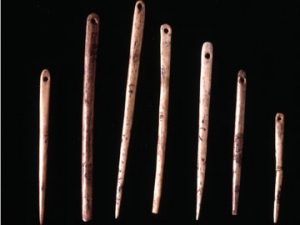
A (sewing) needle is a small, slender and usually rounded tool used to carry a thread of some kind through a piece of cloth or related material, while carrying out plain (structural) or decorative sewing. A needle normally has a hole (eye) at one end and is shaped to a sharp or blunt point at the other.
Selia, Fayoum Oasis (Egypt)
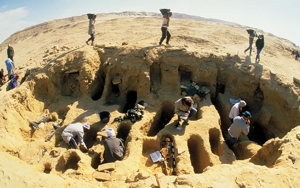
In the early 1980's, excavations were conducted at a Christian cemetery near Selia (also spelt Seila in some sources), along the eastern edge of the Fayoum depression, Egypt. The excavations at Selia were directed by Wilfred Griggs, Brigham Young University, USA. The oldest monument in the region is a four-stepped pyramid dating to the early Third Dynasty (2686-2613 BC).
Rashq Embroidery (Egypt)
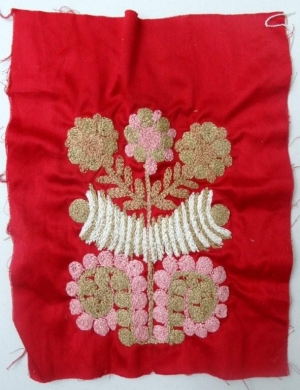
Rashq embroidery is the general name for a form of embroidery from the Delta of Egypt. It originated in a dense form of passementerie used in the nineteenth and early twentieth centuries in Egypt for Bedouin men’s waistcoats. Rashq embroideries are made using a sewing machine with one needle and two separate threads.
Quilt Top
The top layer of a quilt is often made of identical or diverse series of design blocks. These blocks are made separately and then sewn together.
Quills

A quill is the main shaft in a bird’s feather and it is also the name for the hollow spine of a porcupine. They are composed of keratin. Porcupine quills and to a lesser extent, bird quills, have been used for centuries by indigenous communities in Africa and North America to decorate garments and other objects.
Qasr Ibrim (Egypt)

The archaeological site of Qasr Ibrim lies on a bluff overlooking the Nile, Upper Egypt, where it almost never rains, and so high above the river that it was never flooded. This allowed the organic remains to be almost totally preserved. The site was occupied for nearly 3000 years, until the ruling authorities officially ordered its abandonment in 1812.
Qadisha Valley Embroideries (Lebanon)

The Qadisha Valley embroideries were discovered in 1991 by a team of speleologists working in the Qadisha Valley in northern Lebanon. While exploring the Asi-i-Hadath cave complex, they found a series of burials, which included four infants and three adults, skeletal remains of a foetus and one male skull.
Brussels Princess Lace
See Princess lace.
Princess Lace
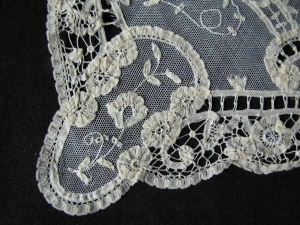
Princess lace is a form of Renaissance lace or tape lace, made in Belgium in the late nineteenth and twentieth centuries. It originally developed as an imitation of Duchess lace. Some authors describe it as a form of lace assembling, rather than lace making.
Powhatan's Mantle
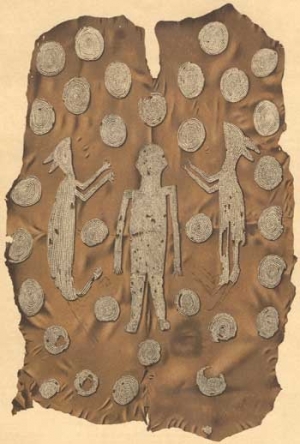
Powhatan's mantle is a native North American garment from the early seventeenth century. It is made of white-tailed deer skin (Odocoileus virginianus, also called Dama virginiana) decorated with applied shells. The mantle is made of four tanned buckskin pieces sewn together with sinew thread (slightly s-spun). It measures 2.33 x 1.5 m.