

Kellis (Egypt)
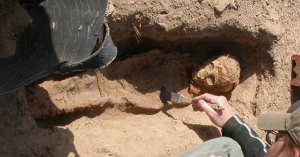
The ancient town of Kellis in Egypt (modern Ismant el-Kharab; ‘Ismant the ruined’) is an archaeological site that lies about 11 km northeast of Mut, the capital of the Egyptian oasis of Dakhla. The ancient settlement consists of a dominant temple complex surrounded by numerous mud-brick structures and is about one square km in size.
El Hibeh Embroidery (Egypt)

El Hibeh is an archaeological site in the Beni Suef Governorate, on the east bank of the Nile, Egypt. The site was occupied since the Third Intermediate Period (1070-712 BC) until possibly early Islamic times (c. seventh century AD). The University of California, at Berkeley, USA, was excavating at the site from 2001.
El Bagawat (Egypt)
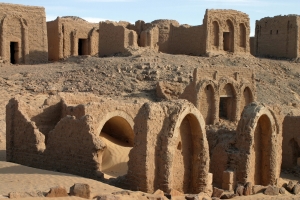
El Bagawat lies about three km from El Kharg, the capital of the Kharqa oasis, in the Western desert of Egypt. Close to the settlement lies an early Christian cemetery. The cemetery consists of numerous domed, mud-brick mausoleums and underground galleries dating to the fourth century AD and later. These were built over an earlier Egyptian necropolis of pit graves.
Embroidered Tunic, Dush (Egypt)
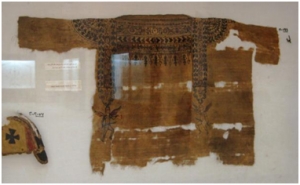
An embroidered tunic was discovered at the archaeological site of Dush, in the south of the Kharqa oasis, Egypt. The site was occupied from at least the mid-third millennium BC until the fifth century AD. Since 1976 the area around Dush has been investigated by the Institut français d’archéologie orientale (IFAO, Cairo).
Deir Abu Metta (Egypt)
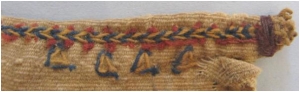
Deir Abu Metta is an archaeological site that lies about eight km southeast of the town of El-Qasr in the Dakhla oasis (one of the oases in the Western Desert of Egypt). Basically, the site consists of an ancient church, a settlement and a Christian cemetery. The earliest occupation phase dates to the fourth century AD or slightly earlier. The church appears to date to the earliest phases and was in use until the seventh century.
Dakhla Oasis (Egypt)
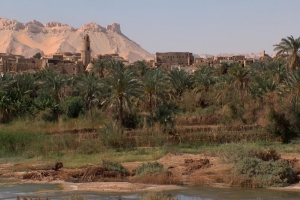
The Dakhla oasis is one of the seven oases of Egypt’s Western Desert. It lies in the New Valley Governorate, about 350 km from the Nile, in the southwest of the country. Two excavations at the third to fifth centuries AD sites of Deir Abu Metta and Kellis have revealed a range of textiles, some of which are embroidered.
Concho
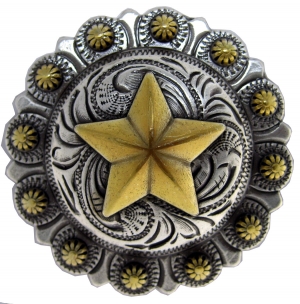
A concho (pl. conchos) is an oval or round metal disc (bracteate) used to decorate belts, clothes, bridles, saddles etc. The term concho derives from the Spanish concha (‘conch’ or ‘shell’). Conchos are common in Mexico and throughout the American West.
Christian Liturgical Colours

There are specific colours for vestments and hangings in the Christian (Western and Eastern) liturgy. The colours are said to reflect the ‘mood’ of the season. The main colours in the Western Churches are black, green, red, rose, violet and white; while those in many Eastern Churches are black, gold, green, light blue, purple or dark red, red and white. These colours are used for the cloth, and sometimes for the embroidery.
Child's Hooded Tunic, Kellis (Egypt)
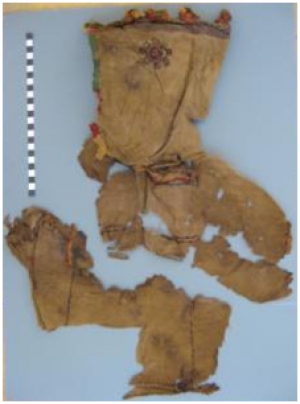
The archaeological site of Kellis (modern day Ismant el-Kharab; ‘Ismant the ruined’) lies about 11 km northeast of Mut, the capital of the Dakhla oasis. Excavations at the site began in 1986, and from 1991 the Kellis excavations were carried out by Monash University, Australia. The main phases of occupation at the site date from the early to late Roman Periods (namely from the first to the fifth centuries AD).
Bess of Hardwick, by Hans Ewouts

A portrait of Bess of Hardwick (Elizabeth, Countess of Shrewsbury, c. 1521–1608) was painted by the Flemish artist Hans Ewouts (Eworth, c. 1520-1574) or one of his students. The painting dates to the 1550's. A later inscription on the painting incorrectly identifies the sitter as Mary I of England (Mary Tudor; r: 1553-1558).