

Dextera Dei
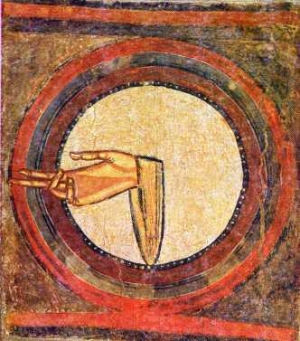
Dextera Dei ('Right Hand of God'), also known as the Manus Dei or Dextera/Manus Domini, is an old symbol of the Christian Church, especially used in Late Classical and early medieval times. It was often applied to indicate God's intervention in the affairs in the world. The symbol of the Hand of God may be linked to an old dislike of representing anything divine as a human figure.
Agnus Dei
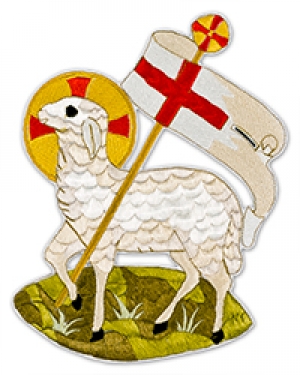
Agnus Dei ('Lamb of God') is an ancient symbol used in the Christian Church, which symbolises Christ and his sacrifice. It contains the lamb, which stands for innocence and sacrifice; the cross, which symbolises Christ's victory over sin, and the three-rayed nimbus, which refers to the divine character of the scene.
Historical Needlework Resources

The Historical Needlework Resources is an ongoing project with digital information about pre-sixteenth century needlework and its technques.
St. Dunstan
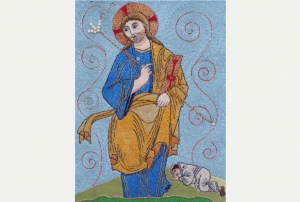
St. Dunstan was an English priest and abbot of Glastonbury Abbey, Bishop of Worcester (and London), and finally from 960 until his death in 988 Archbishop of Canterbury. He played an important role in English politics, and lived in exile in Flanders (955-957). In 973 he officiated at the coronation of King Edgar (the Peaceful), at Bath. The service, devised by Dunstan, still forms the basis of British coronation rituals.
St. Cuthbert Embroideries
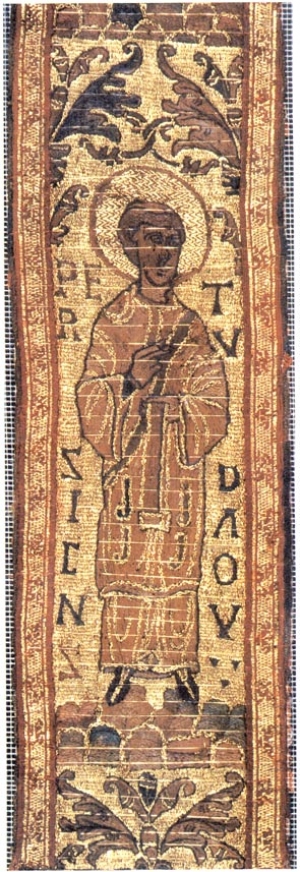
In 1827, the coffin of St. Cuthbert was opened, and in it were found, among other items (including the famous St. Cuthbert Gospel), the remains of a stole and maniple. The garments are nowadays recognised as the oldest extant medieval examples of English embroidery in the country.
Durham Cathedral

Durham Cathedral in northern England, founded in AD 1093, houses a fascinating collection of medieval and later embroideries, including some early medieval examples of decorative needlework. These are a stole, maniple and girdle that date to the early tenth century.
Imperial Mantle of Otto IV (1175-1218)
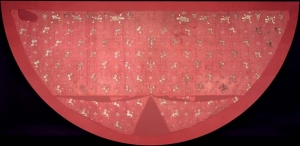
Otto IV (1175-1218) was the son of the German ruler, Henry the Lion and Matilda, an English princess. He was also one of two rival kings of Germany between 1198 and 1208/9 (the other king was eventually murdered, probably at the instigation of Otto).
Cope of St. Kunigunde
The Cope of St. Kunigunde is an eleventh century ecclesiastical garment that is now in the Diocesan Museum, Bamberg, Germany.
Great Mantle of St. Kunigunde
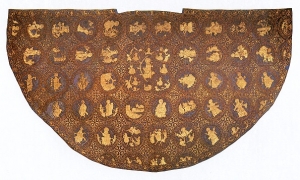
The Great Mantle of St. Kunigunde is an eleventh century garment that is now in the Diocesan Museum, Bamberg, Germany. It is associated with Queen Kunigunde of Luxembourg (c. 975-1040), the wife of Heinrich II (973-1024), who became the Holy Roman Emperor in 1014. The mantle is said to have been given to Bamberg Cathedral by St. Kunigunde.