

Moose Hair False Embroidery

Moose hair false embroidery is a weaving technique often used by the Northeast Indians of North America to decorate objects such as pouches or straps. The technique is called ‘false embroidery’, because the moose hair is not applied to the finished woven item. Instead it is used as part of the weaving process. This technique was especially popular among the Huron and Iroquois peoples.
Moose Hair Couched Embroidery
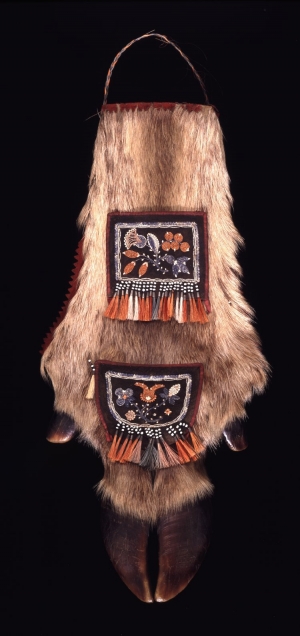
Moose hair couched embroidery is a technique that originated among the indigenous populations of the northern parts of North America. It was practised across the entire territory where moose hair was used for decorative work, although it was most commonly used by the Woodlands Indians in the northeastern part of the North American continent.
Moose hair
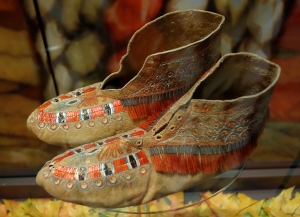
Hair from a North American animal, the moose, has traditionally been used as a textile fibre and thread. In North America, moose hair was particularly used in the northeast of the continent. Moose are known as elk in Eurasia and have the species name of Alces alces. It is the largest member of the deer family.
Detached Buttonhole Filling
See the detached buttonhole stitch.
Leek Embroidery
See the Leek embroidery society.
Quinty, Pierre de
See Peter Quentel.
Knotted Buttonhole Stitch
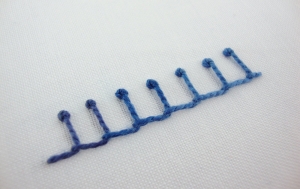
The knotted buttonhole stitch looks very much like a blanket stitch and is often used to fasten the edges of a buttonhole, since it is much stronger that the buttonhole stitch because of the knots.
Hollie Point
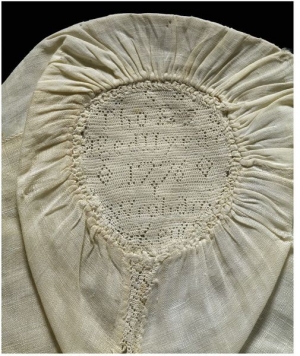
Hollie point (or holy point) is a form of flat needlepoint lace with rows of hollie stitches: knotted buttonhole stitches worked over horizontal, stretched threads. Hollie point was popular in England from the seventeenth to the early nineteenth centuries.
Holy Stitch
See hollie stitch.