

Hungarian Embroidery
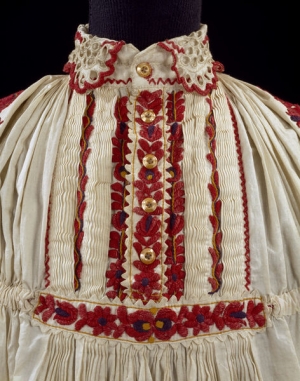
The Central European country of Hungary has a tradition of embroidery that goes back to at least the twelfth century and probably much before. One of the oldest surviving pieces of Hungarian embroidery is the so-called Coronation Mantle of King Stephen (r: 1001-1038), which is now in the National Museum of Hungary, Budapest.
Kloster Lüne
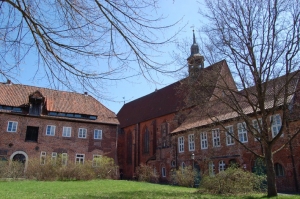
Kloster Lüne (Lüne Abbey) is a medieval abbey in Lüneburg, in the German state of Lower Saxony. The abbey was founded in AD 1172 by a woman called Hildeswidis von Markboldestorp. It would appear that the monastic group was originally a chapter of canonesses and that it was not until about a hundred years later that it became a convent/abbey for Benedictine nuns.
Dame en Désabillé de Chambre
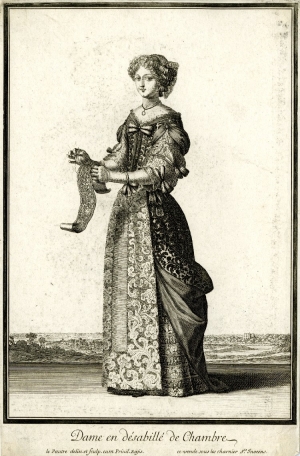
Dame en désabillé de chambre is the title of a print housed in the British Museum, which shows a woman holding a piece of embroidery in her hands. The print dates to about 1675. The woman is shown wearing a long apron that appears to be decorated with lace or whitework embroidery of some kind. She is holding a needle in her right hand and a long band with a stylised floral motif in her left hand.
Mexican Embroidery Print
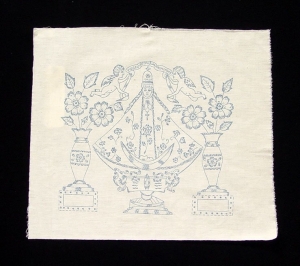
The British Museum in London keeps a square of cotton cloth with a printed embroidery design. The print dates to the 1980's and was purchased in Sierra Norte de Puebla, in southeastern Mexico. The cloth is 42 x 48 cm in size.
Pulpit Fall
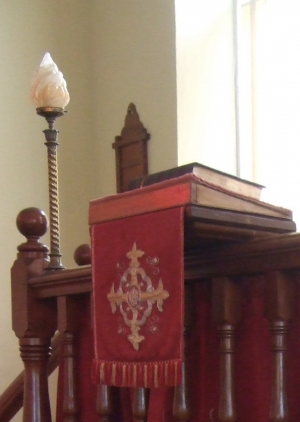
A pulpit is the raised stand in a Christian church that is used during a liturgical service for sermons, readings, and so forth. A pulpit fall is a piece of cloth that hangs down in front of the pulpit. The pulpit fall is often decorated with embroidery of some kind and may come in a variety of different colours, depending on the time of the (liturgical) year and the occasion (a funeral, for example, may have a black pulpit fall).
Queen Victoria's Diamond Jubilee Bimah Cover
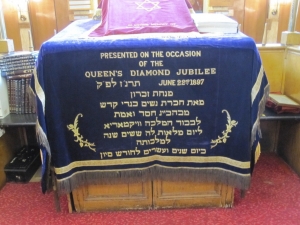
During the 2012 renovations of the Sandys Row synagogue, Spitalfields, London, an embroidered bimah cover was found in the building’s cellar. A bimah is the elevated platform in the centre of a synagogue and is used to support the Torah while it is being read aloud to the congregation.
Bimah Cover
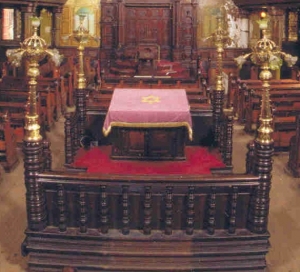
A bimah (Hebrew; pl. bimot; also called an almemor, almemmer or an almemmor) is an elevated platform in the centre of a synagogue. It is used when reading from the Torah, the Jewish holy book. When not in use, the bimah is frequently covered with a decorative cloth, the bimah cover, which is often embellished with metal thread embroidery.
'The Maiden's Chamber'
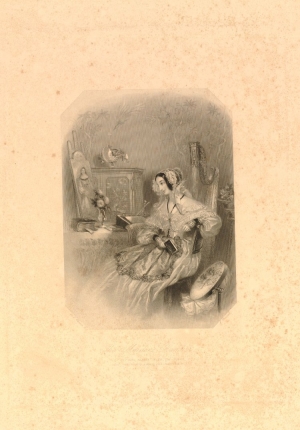
'The Maiden's Chamber' is an English book illustration from 1840 depicting a young lady’s room. The print shows a young woman at her desk with a book in her hand. The print (a steel engraving) is based on an image by the English painter Alfred Edward Chalon (1780-1860) and was made by the artist and engraver, John Jewell Penstone (1817-1902).
Virgin Mary Sewing, by Hieronymus Wierix
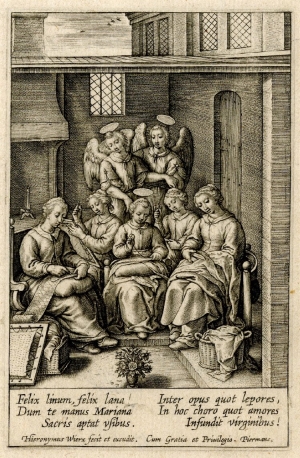
An image by the Flemish print maker, Hieronymus Wierix (1553-1619; at the bottom of the print is the text Hieronymus Wierx fecit et excudit) shows the Virgin Mary. The print dates to 1619 or earlier. It depicts the Virgin seated while sewing, surrounded by other young women sewing and embroidering.
Two Han Chinese Girls Embroidering
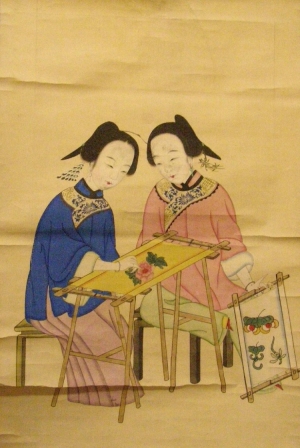
A nineteenth century hanging scroll now in the British Museum (acc. no. 1941,0311,0.1) in London depicts two Han Chinese girls working on pieces of embroidery. One of the girls is using a rectangular stand frame and is embroidering a design of flowers. She is wearing a more formal jacket with embroidered collar and front opening band, with a pink skirt. This type of skirt was often embroidered as well.