

Partlet
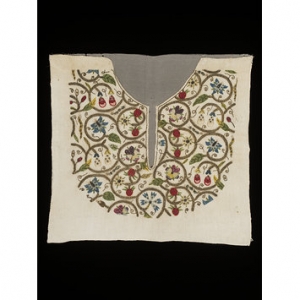
A partlet is a type of upper body garment worn in western Europe, during the sixteenth and early seventeenth centuries. It was more commonly used by women than men. The partlet was used to fill in the low, square neckline of a gown. Middle class and informal aristocratic dress always kept the bosom and neck covered, with either a smock or partlet.
Nishi Kogin

Nishi kogin is a form of kogin zashi (a type of pattern darning) from Japan. Kogin literally means 'small cloth' and zashi means 'stitches'. It is one of the sashiko forms, and was developed by the farmers of the Tsugaru region in the northern part of Honshu Island, Japan, and in particular from west of the Iwaki River.
Kogin Zashi Clothing
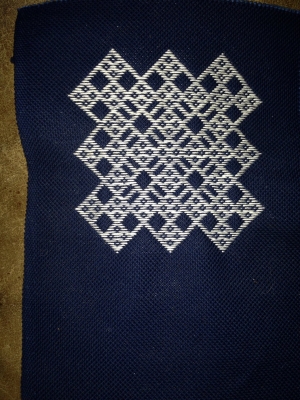
Kogin zashi (or simply kogin) clothing from Japan is a regional style characterised by its decoration with a form of pattern darning. It is regarded as a form of sashiko. It derives from the Aomori Prefecture, in the northern part of Honshu Island, Japan.
Mishima Kogin
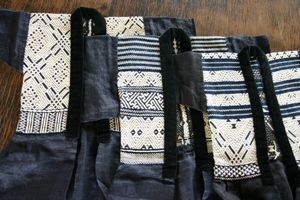
Mishima kogin in Japan is a form of kogin zashi and is characterised by pattern darning. Kogin literally means 'small cloth' and zashi means 'stitches'. Kogin is one of the sashiko forms, which were developed by the farmers of the Tsugaru region in the northern part of Honshu Island, Japan, and particular from the delta of the Iwaki river.
Maximilian I, by Bernhard Strigel
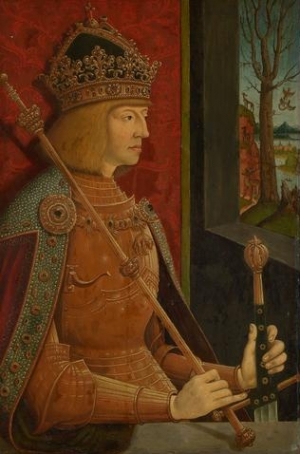
Emperor Maximilian I (1459-1519) was portrayed by the German painter, Bernhard Strigel (1460-1528). The German emperor is shown with his imperial regalia, including crown, staff and sword. The painting dates to after 1507 and measures 85 x 52.5 cm. Over his shoulders the emperor has a red mantle decorated along the edges and back with a broad, turquoise band of applied jewels and pearls.
Mantle of Roger II of Sicily
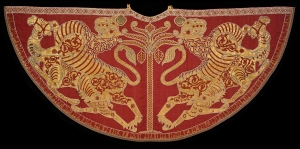
The Mantle of Roger II, the Norman king of Sicily (r. 1130-1154), is made of red silk and is embroidered with gold and silk thread as well as with applied semi-precious and glass jewels. It formed part of the imperial regalia of the Holy Roman Empire. The mantle dates from c. 1134. The garment was made in Palermo, Sicily, probably by Arab craftsmen.
Madame de Pompadour Embroidering
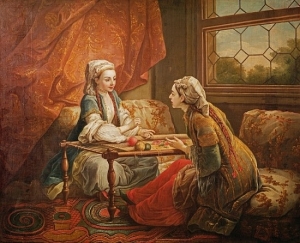
'Madame de Pompadour Embroidering' is a painting by the French artist Carle or Charles-André van Loo (1705-1765). It shows Madame de Pompadour behind an Ottoman-Turkish embroidery frame. The painting dates to AD 1750-1755. Jeanne-Antoinette Poisson (1721-1764), better known as Madame de Pompadour, was the official mistress of King Louis XV of France (r: 1715-1774).
The Laughing Cavalier, by Frans Hals
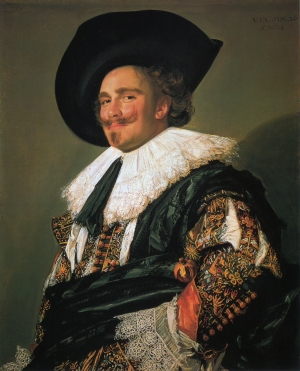
The Laughing Cavalier (as it is popularly known) is a painting of an unknown man, by the Dutch painter Frans Hals (c. 1582-1666). It dates to 1624 and measures 83 x 67.3 cm. The sitter's doublet (type of jacket) is embroidered with red, yellow and white designs, such as arrows, caducei, cornucopias, knots and flames.