

Saddle Cloth, Believed to be of Tipu Sultan of Mysore
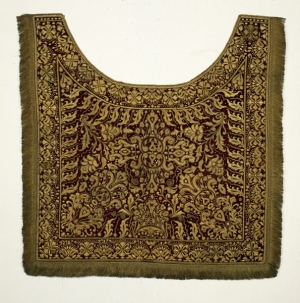
The Victoria and Albert Museum in London houses a saddle cloth from the Deccan in India, which is believed to have belonged to Tipu Sultan of Mysore, who was defeated by the British in AD 1799 at the Battle of Seringapatam (Srirangapatna). The saddle cloth is 143.5 cm high and 142.2 cm wide. It is made of a velvet ground material embroidered with silver gilt thread, with wire and with sequins.
Huqqa Mat
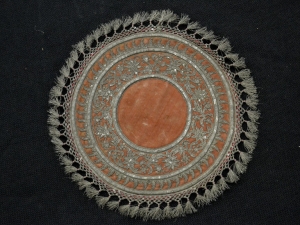
The Victoria and Albert Museum in London houses a decorated huqqa mat (a mat on which a water pipe was placed) from India, perhaps from Delhi, and dating to about the third quarter of the nineteenth century.
Worcester Cathedral Embroideries
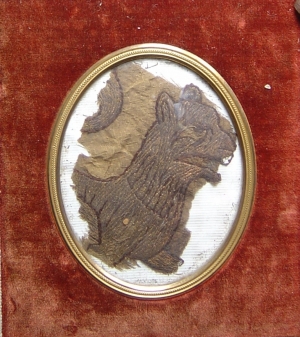
Worchester Cathedral in England owns some medieval embroidery fragments, including a fragment from the burial shroud of King John (1166-1216), made of Chinese silk with a geometric design and decorated with gold thread embroidery in underside couching. It was removed from King John's tomb in the Cathedral in 1797. The embroidery depicts an animal (a leopard?). The outline of the animal is highlighted with chain stitch.
Los Angeles County Museum of Art
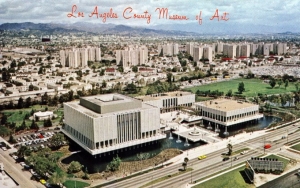
The Los Angeles County Museum of Art is a complex of buildings along Wilshire Boulevard in Los Angeles, California. It was established in 1910 as part of the Museum of Science, History and Art in the park of the University of Southern California. The current museum houses some 150,000 objects, dating from prehistory to the present-day.
King Ahasverus and Queen Esther
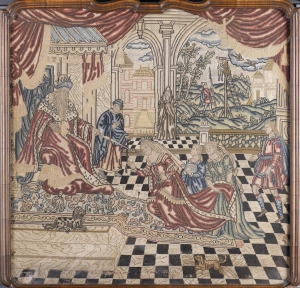
The National Museums Scotland houses an embroidered picture, probably originating from Italy and dating to the second half of the seventeenth century. It represents the (Apocryphal) Biblical story of the Persian King Ahasverus and (the Jewish) Queen Esther, and the Persian vizier, Hamam (Book of Esther 7). The embroidery is worked in coloured wools and silks on a linen ground.
British Purse, Early Seventeenth Century
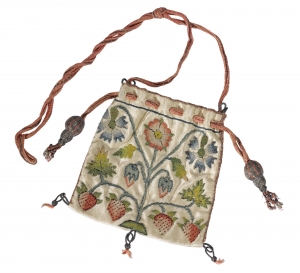
The National Museums of Scotland house an early seventeenth century purse from Britain. It is made of white satin and decorated with petit point embroidery in coloured silks.
Bidang, Borneo, Indonesia

The National Museums of Scotland house a late-nineteenth century bidang, a woman's skirt, from Borneo, Indonesia. It is made of cotton and decorated with shells, beadwork and embroidery.
Maria Amalia, Duchess of Austria, Engaged in Embroidery
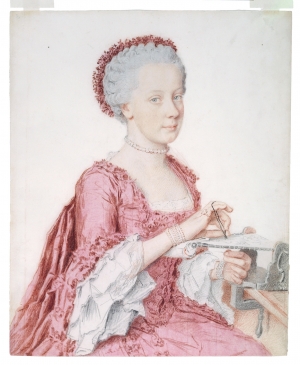
A water colour and pastel by the Swiss-French artist, Jean-Étienne Liotard (1702-1789) and dated 1762, shows Maria Amalia (1746-1804), archduchess of Austria and the future Duchess of Bourbon-Parma, engaged in embroidery.
Marie Antoinette Engaged in Netting
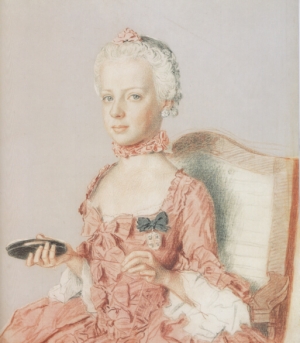
A water colour and pastel by the Swiss-French artist, Jean-Étienne Liotard (1702-1789) and dated AD 1762, shows the seven-year old Marie Antoinette of Austria (1755-1793) engaged in netting. She is holding a netting shuttle in her right hand.
Book Cover from USA, 1799

The Los Angeles County Museum of Art houses an embroidered book cover that dates to AD 1799. The cover is made of silk satin and paper, and is embroidered with silk thread. It measures 15.24 x 12.38 cm.