

Langdale Linen Industry
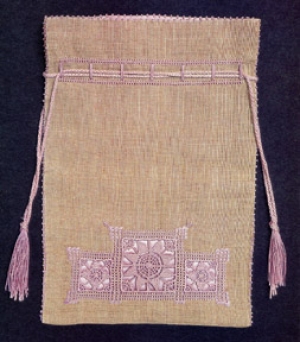
The Langdale Linen Industry was set up in Westmorland, Cumbria, by Alfred Fleming, with the support and patronage of William Ruskin (1819-1900) and upon earlier work carried out by Miss Susanne Beever (1805-1893), who came from the area and who was the editor of Ruskin's book, Modern Painters. The Industry was initally led by Fleming's housekeeper, Marian Twelves.
Bland, Sarah (1810-1905)
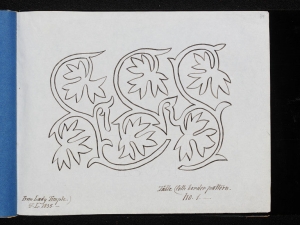
Sarah Bland (1810-1905) was listed as a 'gentlewoman' in the British 1851 census, and she is not listed as having an occupation in succeeding censuses. She is however known for her many designs, of a very high quality, that she copied or designed for embroidery, and which she collected into an album. Many of the designs are now held in the Victoria and Albert Museum, London.
Shepheard Buss
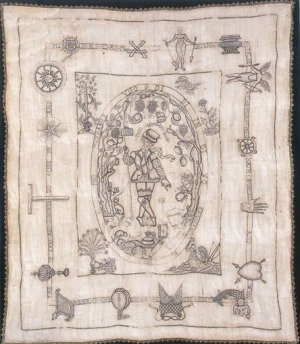
The Victoria and Albert Museum in London houses a remarkable example of blackwork, the use of which remains a moot point. It may have been a wall hanging, a cupboard cover or a table cover. It was made in England and dates to the late sixteenth century. It measures 114 x 98.3 cm. It is embroidered in black silk on a linen ground. There is also couched cord and a bobbin lace border.
Linwood, Mary (1755-1845)
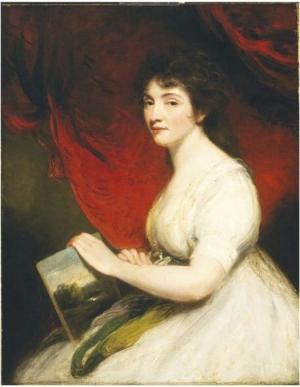
Mary Linwood was a renowned embroideress who specialised in the technique of needlepainting, whereby oil paintings and other illustrations are exactly copied in embroidery against a painted background. She was born in Birmingham, and by 1776 she was exhibiting her work to the Society of Artists in London.
Napoleon Bonaparte
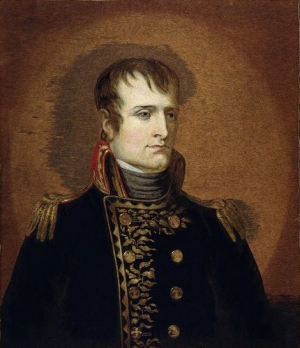
The Victoria and Albert Museum in London houses an embroidered picture of Napoleon Bonaparte, which was made by Mary Linwood (1755-1845) in 1825. The technique she used was needlepainting, whereby oil paintings and other representations were exactly copied with hand embroidery, against a painted background. The embroidery measures 78.3 x 71.2 cm and was carried out in crewel wool on a wool ground.
Tomb of Archbishop Walter de Gray
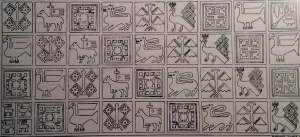
The tomb of Walter de Gray, Archbishop of York from 1215-1255, and one of those present at the signing of the Magna Carta in June 1215, is located in the south transept of York Minster.
Chichester-Constable Chasuble
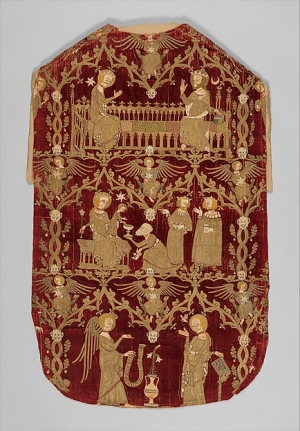
The so-called Chichester-Constable chasuble is now housed in the Metropolitan Museum of Art, New York. It was made in England, in the opus anglicanum tradition, in the mid-fourteenth century. It measures 129.5 x 76.2 cm. It used to be larger, but was cut to its present (fiddle) shape in the sixteenth century to conform to contemporary fashion. Some of the off-cuts were used to make a stole and a maniple.
Cloth of Gold
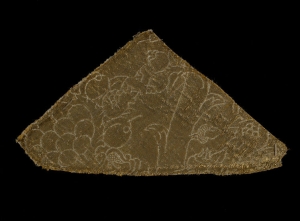
Cloth of gold was an extremely expensive fabric produced at different periods and in different parts of the world, but especially known from late medieval Europe, and produced particularly in northern Italy. It is characterised by gold (or sometimes silver) threads (normally passing) woven into a precious, often a silk fabric, creating a stiff and heavy (and very expensive) material.
Amice

An amice (Latin: amictum) is a liturgical garment worn mainly in the Western Catholic Church and in some of the Protestant Churches. It is a separate, rectangular piece of linen worn across the shoulders and fastened around the back and waist. It is normally made of a plain fabric, but it sometimes has embroidered decoration.
Alb
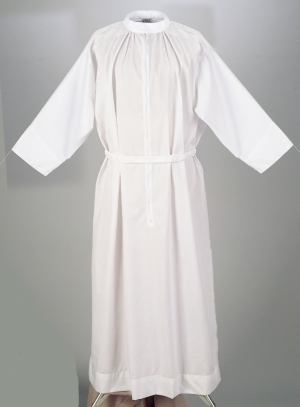
The alb (Latin albus, 'white') is an ecclesiastical vestment of some of the Western Churches, including the Anglicans, Lutherans, Methodists and Roman Catholics. It is used by all levels of the Catholic clergy. It is generally worn over the cassock, and under the chasuble or dalmatic and is usually girdled with a cincture. It derives from the Roman-period, long-sleeved tunica alba, which in the Roman Empire was worn by the well-to-do.