

Cope of the Order of the Golden Fleece
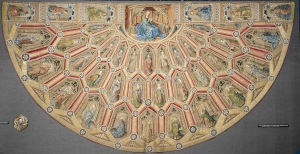
The Kaiserliche Schatzkammer in Vienna, Austria, houses a remarkable cope that dates to the early fifteenth century and was produced in the southern Netherlands or beyond. It is worked in the or nué technique, with couched gold thread embroidery. This technique was popular in The Netherlands in the fifteenth and sixteenth centuries. The cope measures 164 x 330 cm.
Hood of a Cope, with the Seven Sacraments, 15th Century

The Historical Museum of Berlin, Switzerland, houses various fragments of a cope, including the hood, which is embroidered with scenes of the Eucharist, as executed in the Devotio Moderna. This new development in the Catholic Church developed in the late fourteenth and early fifteenth centuries in The Netherlands and Germany.
Antependium of Middelburg
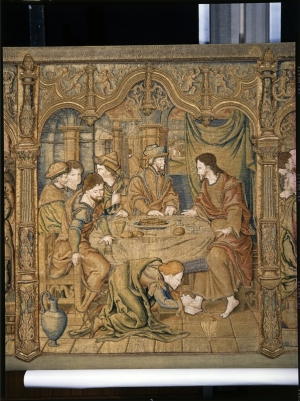
The Antependium of Middelburg, also ascribed to Grimbergen and Nassau, dates to the early sixteenth century and is a prime example of the famous or nué technique, which flourished in the Netherlands in the late medieval period. It measures 377 x 93 cm and is housed in the Koninklijke Musea voor Kunst en Geschiedenis, Brussels (inv. no. Tx 1279; obj. no. 20014717).
Or Nué
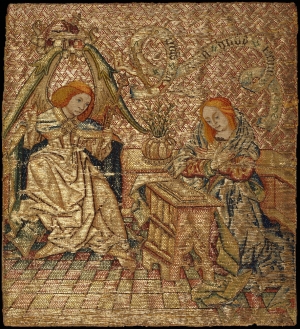
Or nué ('shaded gold') is a form of goldwork embroidery worked with a couching technique, whereby different coloured silk threads are stitched over the gold threads in order to form various designs. The or nué garments are slightly later in date than the equally prestigious opus anglicanum vestments.
Rank Badge from Nineteenth Century Korea

The Metropolitan Museum of Art in New York houses a nineteenth century rank badge from Korea (locally known as hyungbae), measuring 21 x 19.1 cm. I ts embroidered in silk on a silk satin damask ground material. The badge is decorated with the representation of two cranes.
Man's Leather Belt from Romania
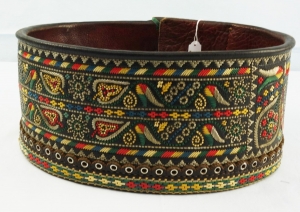
A broad, embroidered, man's leather belt is housed in the collection of the Textile Research Centre, Leiden, The Netherlands. It is 104 cm long and 14 cm broad. It is made from a wide band of leather decorated with stylised floral and geometric motifs worked in coloured stripes of plastic using running and back stitches. The belt is further decorated with metal eyelets. It is fastened with three large belt buckles.
Rank Badge from Nineteenth Century China
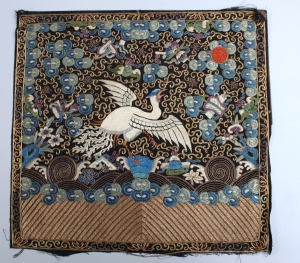
The Textile Research Centre in Leiden houses an embroidered rank badge or panel, from late nineteenth century China. It measures 31 x 29 cm and is made of a silk ground material and silk and metal thread embroidery, with applied coral beads.
Embroidered shoes from Gilan, Iran
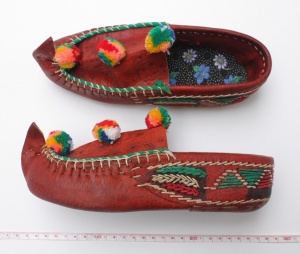
A pair of embroidered women's shoes from the Iranian province of Gilan, in the north of the country along the Caspian Sea, is in the collection of the Textile Research Centre, Leiden, The Netherlands. The footwear dates to the twentieth century. The shoes are made of leather and cotton, and decorated with vegetable fibres. They were acquired in Gilan in 1998.
Embroidery Printing Block (India)

The Textile Research Centre in Leiden holds a number of printing blocks from India. They include blocks specifically used for transferrring designs in preparation of embroidery. The present block is about 5 x 5 cm. In the centre it has an X-shaped motif enclosed by squares with an elaborate outer border.
Sari Band (India)
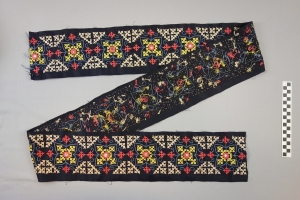
The Textile Research Centre in Leiden, The Netherlands, houses a remarkable set of a printing block and two embroidery samples. The printing block and the two samples, including the sari band, illustrated here, originate from India and they date to the early 21st century. The other sample, or test piece, was worked with the help of the printing block.