

Teste piece for Indian embroidery
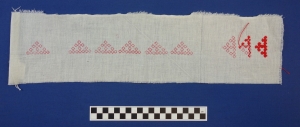
The Textile Research Centre in Leiden, The Netherlands, houses a remarkable set of a printing block and two related embroidery pieces. The printing block and one of the pieces, a sari band, originate from India and they date to the early 21st century. The other sample, or test piece, illustrated here, was worked with the help of the printing block.
Printing block for embroidery (India)
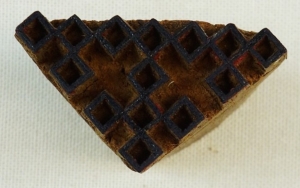
The Textile Research Centre in Leiden, The Netherlands, houses a remarkable set of a printing block and two embroidery samples. The printing block and the samples (one of which is a sari band) and the other a test piece) originate from India and they date to the early 21st century. The printing block, illustrated here, measures about 4 x 3 cm.
Sample of 1930's Fashion Couching with Black Cords
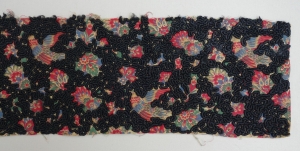
The collection of the Textile Research Centre in Leiden holds a sample (76 x 13 cm) of cotton cloth with a printed design of stylised birds and flowers. It has the spaces between the individual floral and bird designs filled with a vermicelli design of thick cords that are couched to the ground material. The sample dates to the 1930's and probably derives from France.
Sample of 1930's Fashion Couching with Beige Cords
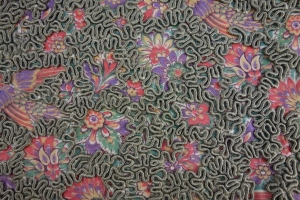
The collection of the Textile Research Centre in Leiden holds a sample (41 x 20 cm) of cotton cloth with a printed design of stylised birds and flowers. What is remarkable is that the spaces between the individual floral and bird designs are filled with a vermicelli design of thick, beige cords that were couched to the ground material. The sample dates to the 1930's and probably derives from France.
Fishmongers' Pall
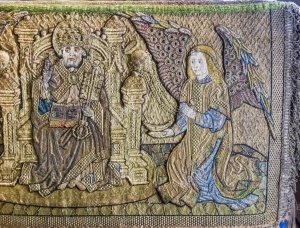
The Fishmongers' Pall is a lavishly embroidered funeral pall created by nuns between 1512 and 1538, for the Worshipful Company of Fishmongers, which still owns the cloth (Fishmongers' Hall). The four side panels of the pall are all fully covered with embroidery. The top is made of the richest Italian cloth of gold, while the sides are made of linen. The pall measures 232 x 56 cm.
Jesse Cope
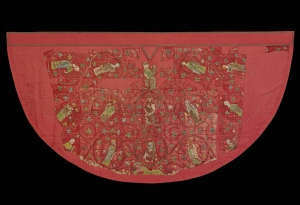
The Jesse cope, now housed in the Victoria and Albert Museum, London, consists of a number of embroidered fragments sewn together into a cope. The fragments are decorated in the tradition of opus anglicanum. They date to the early fourteenth century.
Toledo Cope
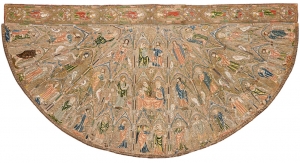
The Toledo cope, worked in England in the early fourteenth century in the tradition of Opus Anglicanum, is housed in the Catedral Primada de Santa Maria in Toledo. It is embroidered with foliage and birds, and features the Virgin Mary and saints. The scenes are framed by gothic arches.
Daroca Cope
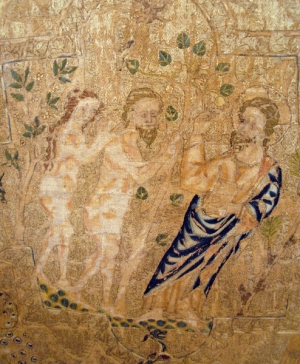
The Daroca cope (also known as the Madrid cope) is a famous example of medieval opus anglicanum, which is housed in the Museo Arqueológico Nacional, Madrid, Spain. The cope shows scenes from the Creation of the World and Fall of Adam and Eve. It is an exceptional example of opus anglicanum, since scenes from the Old Testament are rarely depicted in medieval embroidery from England.
Pontifical Stockings in Opus Anglicanum
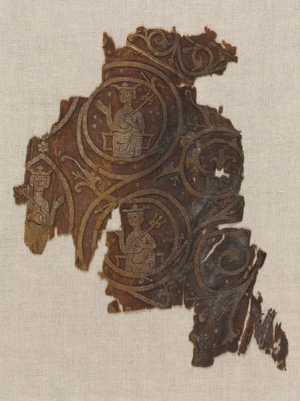
The Victoria and Albert Museum in London holds in its collection a fragment (c. 29 x 22.5 cm) of what has been suggested to be a pair of pontifical stockings/boots, worked in opus anglicanum. They were retrieved from a tomb in Worcester cathedral in 1861, believed to be that of Bishop Walter de Cantelupe (who died in AD 1266).
Opus Anglicanum embroideries in Trondheim, Norway
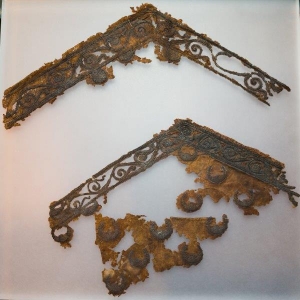
The upper part of two boots or stockings to be worn by a bishop, and worked in Opus Anglicanum with gold and silver thread embroidery, are preserved in the Archbishop’s Palace Museum, at the Nidaros Cathedral in Trondheim, Norway. They probably date to the late twelfth century. Nidaros is the medieval name of Trondheim.