

Hishizashi is an embroidery style from the Nanbu region in the north of Honshu, Japan. Hence it is also sometimes called Nanbu hishizashi (Nanbu diamond stitch). It developed out of the practice of reinforcing (hemp) garments with cotton threads. It may be classed as one of the sashiko forms.

Furoshiki (風呂敷) represent a form of traditional Japanese wrapping cloth. They may be made of various materials, including silk, cotton, or synthetics. They may be decorated with printed designs or embroidery. They vary in size from that of a handkerchief to that of a large bed-spread. Their popularity in modern Japan decreased after the Second World War, but recent initiatives try to revitalise this old tradition.
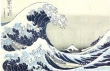
Katsushila Hokusai was an artist, painter and printmaker, who became especially famous for a series of woodblock prints 'Thirty-six Views of Mount Fuji', which includes the world-renowned print, 'The Great Wave off Kanagawa', made in the 1820's. He is sometimes accredited with having inspired the development of certain motifs of Japanese embroidery, as for instance in sashiko work.
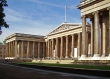
The British Museum is an internationally renowned museum located in central London. It was founded in 1753 and opened to the general public in 1759. The museum houses a vast collection of about eight million items that range in date from prehistory to the present. It includes items from all the continents of the world.
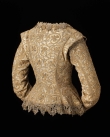
The Wodehouse jacket is an early seventeenth century woman’s garment housed in the Boston Museum of Fine Arts, USA. The jacket dates to 1610-1615 and appears to have been altered at a later period. It is made from an undyed linen (tabby weave), and decorated with silk and metallic threads, as well as spangles and bobbin lace made with a metallic thread. The design on the jacket consists of a daffodil scroll pattern.
A detached fly stitch is a variation on a fly stitch, in which the stitches are worked detached from one another. GVE

"Atmaran, Hindoo of Peshawar" is the title of a coloured lithograph made by E. Walker (d. 1882), based on the work of James Rattray (1818-1854), who was based in Afghanistan during the First Anglo-Afghan war (1838-1842). Atmaram was a Hindu from Peshawar in modern northern Pakistan, who had become the 'minister' of a local Muslim and Uzbek ruler in northern Afghanistan, Mohammed Murad Beg of Kunduz.

The illustration with the caption “The Ameer of Afghanistan at home: Life in His Majesty’s harem” was drawn by Balliol Salmon based on material supplied by Mrs. Kate Daly, who for many years was physician to the ladies of the Amir's harem, and who just before had returned to England. The illustration was published in The Graphic, 26 November 1904, p. 697.

Guimarães whitework is a form of decorative needlework that derives from Guimarães in northern Portugal. It is a sub-group of Guimarães embroidery. Guimarães whitework was used to decorate both men and women’s clothing (especially chemises, shirts and waistcoats), as well as household items, such as curtains and towels.
More...

The fern stitch is a simple technique to form sprays or leaf veinings. It includes three straight stitches, of equal length, worked in different directions from one central point.

A double lazy daisy stitch, or double lazy stitch, is in fact a double or triple ring of lazy daisy stitches. After working a ring of lazy daisy stitches, another ring in another shade or colour is embroidered around it, and another ring may be worked around the second ring.

Guimarães embroidery is a form of decorative needlework that derives from Guimarães in northern Portugal. It is known locally as Bordado de Guimarães. There are written references to the production of embroidery in this region dating back to the tenth century.