

Sardinian knotted embroidery is a form of whitework from the town of Teulada, in southern Sardinia. Teulada embroidery is locally called Punt ‘e Nù (‘knotted stitches’) and is a form of counted thread work. The main stitch is the coral stitch, which is worked in geometric patterns of varying degrees of complexity. The designs are usually worked in diagonal lines, working from left to right.

The Mansudae Art Studio complex in Pyongyang, North Korea, is perhaps the largest 'art' production complex in the world. According to its official webside, run by the Italian firm of Pier Luigi Cecioni, the North Korean firm employs some 4000 people and covers a surface of some 120000 square metres. It produces a wide range of objects, including ceramics, (huge) bronze statues, oil paintings, and embroideries.
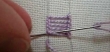
The ladder stitch is a technique that forms a tight braid on either side of a 'ladder'. It is a technique used to create a decorative border. The name ladder stitch is sometimes used for the open chain stitch or the ladder hem stitch. Also known as blind stitch, hidden stitch, or slip stitch.
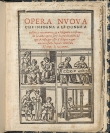
Giovanni Antonio Tagliente, from Venice, Italy (c. 1465-1528?) was an author, calligrapher, printer and publisher, who in 1527 published a pattern book (Opera Nuova ... Intitolata essempio di recammi), which also included descriptions of how to transfer a pattern to a textile ground material.
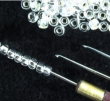
In some publications no difference is made between a tambour hook and an ari hook, especially as these hooks are only slightly different in shape and both are used for similar types of embroidery as well as beading. Both hooks, for example, are used in a similar way for chain stitch embroidery.
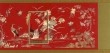
Depictions of famous people, moments of historical significance, well-known buildings and land marks often appear on postage stamps from around the world. Considerably rarer are stamps that depict textiles, especially embroidery. Some of these stamps are part of a series about folk art in general, others are deliberately dedicated to the subject.

The Lily Yeats embroidery competition was started in 2013 as part of the annual Sligo Lily Lolly Craftfest, named after Lily and Elizabeth ('Lolly') Yeats. Lily Yeats (1866-1949) was a famous designer and embroiderer who worked in England and Ireland. The competition is open to students from Home Economic courses in colleges throughout Ireland and is organised by St. Angela’s College, Sligo.

The Dun Emer Guild and the Dun Emer Industries were two Irish companies based in Dundrum, Ireland. They were at the forefront of the Celtic Revival of the early twentieth century and the use of Celtic Revival designs for embroidery. The initial company, Dun Emer Guild, was set up in 1902 by Evelyn Gleeson (1855-1944) and two sisters, Lily Yeats (1866-1949) and Elizabeth Yeats (1868-1940).

Elizabeth Corbet Yeats (1868-1940), also known as Lolly, was a painter and designer associated with the Celtic Revival. Being the daughter of the Irish artist, John Butler Yeats, her siblings included John ('Jack') Butler Yeats (artist and Olympic medallist), William Butler Yeats (the famous Irish poet) and Susan Mary ('Lily') Yeats (embroiderer and co-founder of the Dun Emer Guild).

Susan Mary ('Lily') Yeats (1866-1949) was a designer and embroiderer associated with the Celtic Revival movement of the late nineteenth and early twentieth centuries. She was born in Enniscrone (County Sligo), and was the eldest daughter of the famous Irish portrait artist, John Butler Yeats and Susan Yeats (née Pollexfen).
More...
Kells embroidery is a form of Celtic Revival work, which dates from the early 1880's.

Alice Marion Hart (c. 1850-1931; née Rowland) was born in London, one of eight children. Her father was Alexander Rowland, a wealthy businessman, and her sister was Henrietta Barnett, a well-known nineteenth century social reformer and educationalist. In 1872 Alice Rowland married Ernest A. Hart (1835-1898), a surgeon and editor of the British Medical Journal. Alice Rowland was his second wife.

In the Royal Collection, London, there is a series of water colour vignettes by the English painter and cartoonist, Alfred Pearse (1855-1933). One of these vignettes depicts the moment when the Archbishop of Canterbury crowns King George V of Great Britain, on 22 June 1911. The archbishop is wearing a highly decorated cope in red with embroidered orphreys down the front opening.

In the Royal Collection, London, there is a series of water colour vignettes by the English painter and cartoonist, Alfred Pearse (1855-1933). They depict the coronation of King George V of Great Britain (1865-1936) on 22th June 1911. One of these paintings depicts three of the attending bishops, all wearing highly decorated copes with embroidered orphreys down the front. They carry the Bible, the Chalice and the Plate.