

In the year 2000, the London-based hand embroidery company of Hand & Lock established a prize for embroidery. The prize was originally conceived by the chairman of the company, Alastair Macleod, as a way of encouraging the use of embroidery in the fashion and textile world and to allow young designers from around the world to showcase their finest creations.

Hand & Lock is an embroidery firm based in London, England, which was created in 2001 by the fusion of two embroidery businesses, namely that of M. Hand and S. Lock. These two firms themselves had a long history.
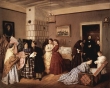
In many parts of the world a girl’s dowry, or the property and money that she and her family bring to a marriage, played an important role in the history of embroidery. Basically a dowry is the transfer of parental property and/or money to a daughter on her marriage. It is usually given to her husband or his family, but in many cultures the dowry remains the property of the woman to whom it is given.

Bilderbuch für Kinder ('Picture Book for Children') was an illustrated natural history series aimed at children composed by the German publisher, Franz-Johann Bertuch (1747-1822). The book(s) came out in twelve volumes between 1792 and 1830. Images from the book were sometimes used for embroideries.
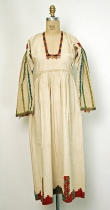
A chemise is an undergarment that has the form of a dress. It was worn for centuries by women throughout Europe, both urban and rural. But the widespread use of chemises had virtually died out in Europe, including in the Greek mainland and islands (they were called poukamiso in Greek, by the latter half of the twentieth century.
Koukoulíthra is a cotton/silk woven cloth that was sometimes used on the Greek island of Skyros as a ground material for embroideries.

The Boston Museum of Fine Arts (MFA), in Massachusetts, USA, was founded in 1870 and moved to its present buildings in 1909. The MFA houses over 450,000 objects from all over the world and from thousands of years ago (ancient Egypt) to the present day. Most of its textile collection is housed in the David & Roberta Logie Department of Textile & Fashion Arts. In 2015 there were over 27,000 items in this department of the museum.

Leonardo da Vinci is the name for a particular design used for Lefkara lace from the island of Cyprus. The design is locally called potamos.
More...

It is not always clear where Cyprian redwork originated. Some authors attribute this style of work to Lefkara, others say it comes from the southern coastal town of Pafos and the surrounding region. What is clear is that this type of work was known in the seventeenth and eighteenth centuries, and possibly still in the nineteenth century.

Cyprus is the third largest island in the Mediterranean Sea and lies just south of Turkey. It has a long tradition of decorative needlework, in particular redwork and whitework. For centuries the island has been part of an intensive maritime network that linked the whole of the Mediterranean world together.

Milos Pholegandros is an island in the Greek Cyclades archipelago. This particular embroidery from the island dates to the eighteenth century. It was probably originally part of a valance. It is made on a linen ground with coloured silk threads. The embroidery was carried out using chain stitch, cross stitch, long-armed cross stitch, darning stitch and satin stitch.
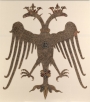
The double headed eagle is an ancient Anatolian symbol that dates back to the period of the Hittites (Anatolia; second millennium BC), if not earlier. By the medieval period the double headed eagle was widely used for heraldic images within the Byzantine Empire (c. 330-1453), and hence also in the Holy Roman Empire (962-1806), as well as the Russian Empire (1721-1917).