
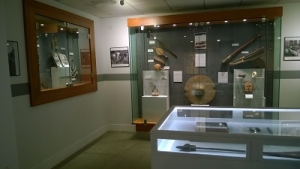
The Ethnography Collections of the Department of Anthropology, University College London, were established together with the foundation of the Department of Anthropology, in 1945. Much of the collection was donated in the mid-twentieth century and acquired during fieldwork by staff, notably by Prof. Daryll Forde, who established the department.

Bed tents (Gr: sperveri) are a particular form of bed furnishing, known from the Greek Dodecanese (literally ‘Twelve Islands’) in the Aegean Sea, close to the Turkish coastline. The Dodecanese includes twelve large (including Rhodes) and about 150 smaller Islands.

The Izumo Museum of Quilt Art is the first quilt museum in Japan. The main collection on display consists of the work of Ms. Mutsuko Yawatagaki. The museum was opened in 2006 and is located in the Izumo region, which is widely considered to be one of the cradles of Japanese art and civilisation.

Cornelia Ann Parker (1956) is an English sculptor and installation artist who was the creative power behind the Magna Carta embroidery. She has had exhibitions of her work in various countries around the world, including Britain, China and Italy. There are examples of her work in the Metropolitan Museum of Art, New York, as well as at the Tate Gallery and the Henry Moore Foundation in the UK.
Pierrot embroidery was a novelty form of embroidery developed in the USA in c. 1915. It remained fashionable for only a short period.

Dundee University houses a substantial collection of embroideries and related textiles that were donated to the Dundee College of Art (now called the Duncan of Jordanstone College and part of the University of Dundee). The embroideries were donated after 1961 by the Needlework Development Scheme.

The Needlework Development Scheme (NDS) was a collaborative project between art and design education and industry and was set up in Scotland in 1934. The aim of the NDS was to encourage the use of embroidery and to raise the standards of (commercial) design in Britain. It was financed by the Scottish thread manufacturers, J. and P. Coats (based in Paisley).

Madame Eugénie Luce (1804-1882) was a French teacher who established the first French/Arab school for Muslim girls in Algiers (Algeria) in 1845. Particular attention was paid in the school to embroidery. It is often stated that she was a widow, but in reality it would appear that she had left her husband because of domestic abuse. In order to support her children, she became a governess and moved to Algiers, probably in 1834.

A feature of nineteenth and early twentieth century embroidery in North Africa was the influence of various Christian missionaries from Europe and America. In particular Catholic missionaries were active in North Africa, notably in French colonised Morocco, Algeria and Tunisia, and in the Italian colony of Libya.
More...
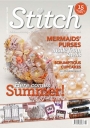
The Stitch magazine is produced by the Embroiderers' Guild (London). It is geared towards the ‘Textile Arts’ and is basically aimed at the domestic embroiderers market. It regularly has, for example, projects of varying degrees of difficulty for its members to carry out.

The Embroidery magazine is produced by the Embroiderers' Guild (London). It is geared towards both domestic and professional embroiderers. It was first published in 1932 with two issues per year. One of the first people to write for Embroidery was Grace Crowfoot. In 1950 Embroidery started to come out four times per year and then in 1996 the number of issues was increased to six issues per year.
Naples lace, or punto di Napoli, is a form of bobbin lace that resembles Milanese (tape) lace, but it characterised by its rounder mesh and coarser appearance.

Genoese lace is a form of guipure, bobbin lace that in the early nineteenth century was introduced in Malta and, with the addition of the Maltese cross in the design, developed into Maltese lace.