

The plait stitch (also known as the Spanish stitch) should not be confused with the plaited, or herringbone stitch. It is generally worked on even weave cloth and creates a raised, dense and plaited surface.

The bouclé stitch is a form of looping, in which a series of small loops are worked on the surface of the cloth. Sometimes, as in Morocco, these loops are worked into specific patterns, whose form can only be seen on the back of the cloth. On other occasions, the bouclé stitches are worked in a random manner.
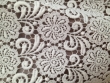
Guipure lace is a form of bobbin lace, whereby the patterns are connected with bars or plaits, and not with a mesh or net. The patterns, placed closely together, used to be outlined with a thicker thread (gimp). Guipure lace has an almost three-dimensional, raised appearance. It is nowadays also often known as Venetian lace.
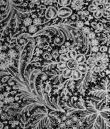
Duchess lace, or Duchesse lace, was produced in Belgium (and in particular in Brussels and Bruges) from about the mid-nineteenth century onwards. In general it was regarded as a cheaper version of 'true' Brussels lace. It is a form of bobbin lace. The bold motifs are joined by thin bars (brides). It is reportedly named after Marie-Henriette, duchess of Brabant.
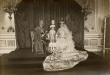
A photograph of Karl Franz Joseph Ludwig Hubert Georg Otto Marie von Habsburg (1887-1922) was taken shortly after his coronation in Budapest on 30th December 1916 as King Charles IV of Hungary. He was also installed as Emperor Charles I of Austria and successor of Franz Joseph, King-Emperor of the Austro-Hungarian Empire, who had died in November.
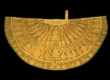
The Hungarian Coronation Mantle is a semicircular cloak densely embroidered with gold and silk. It dates to the eleventh century. The mantle is part of the coronation regalia of Hungary since at least the thirteenth century. The mantle was last worn at the coronation of Charles IV in 1916. After the Second World War (1939-1945), the coronation regalia, including the mantle, were sent to the USA for safe keeping. They were returned in 1978.

The detached buttonhole stitch is a filling stitch, which is used to make a raised area. It is created by first making two or more horizontal straight stitches on top of the area to be worked. Then a line of buttonhole stitches is made, being woven into the straight stitches, going from left to right, without entering the ground material.

Sashiko ('little stabs' in Japanese, from sasu, 'to pierce') is a form of embroidery using a running stitch, usually with a white thread on an indigo blue background. This type of embroidery is found all over Japan, but particularly in the (colder) north.

The family of the Antwerp artist, Cornelis de Vos (1584-1651) was painted by the artist in 1621. The painting is now in the Koninklijke Musea voor Schone Kunsten van België (Royal Museums of Fine Arts of Belgium), in Brussels.
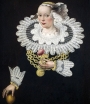
Hand ruffs are attached to the cuff of a shirt or chemise worn by both men and women. Hand ruffs were popular from about AD 1560 to 1650. They were often decorated using embroidery, lace and/or spangles, often in the same manner as the main ruff worn around the neck. During the sixteenth century the term ‘ruffles’ was regarded as synonymous with hand ruffs.
More...

A ruff, or neck-ruff, was a fashionable garment worn in Western Europe from the mid-sixteenth to the mid-seventeenth centuries. They were worn by urban men, women and children. Ruffs were often embellished with lace (bobbin lace, embroidered lace), embroidery or a combination of these forms. The lace, and the full ruff, were sometimes also known as a piccadill. The garment is probably of Spanish origin.

The rice stitch is a variant of the cross stitch, whereby the four 'arms' are covered by small, diagonal stitches. These small stitches can use a thread of the same colour, or a different thread is used to create an extra effect. The rice stitch is also known as 'crossed corners'.

The zigzag stitch is a simple technique, which looks like a row of cross stitches separated by vertical stitches. First a line of vertical stitches and of one direction of the diagonal stitches is embroidered, from left to right; upon the return of the needle, and working from right to left, the opposing diagonal stitches are made.

A diagonal stitch is used on canvas and is applied to fill large areas with the effect of woven or brocaded material. It consists of a satin stitch (or tent stitch) being worked in diagonal rows from top left to bottom right hand corner.