

The Musée Provincial des Arts Anciens du Namurois, Namur, Belgium, houses a mitre that is embroidered with silver-gilt and silver thread, and coloured silk embroidery, worked with underside couching, split stitch and stem stitch on a silk ground material. The mitre is 18.8 cm high and 28 cm wide.

The Early Bronze Age burial mound of Skrydstrup, southern Jutland, Denmark, has yielded a very early example of needlelace, from the sleeve and neckline of a garment buried together with a young woman in an oak coffin. The burial mound was excavated in 1935 and the remains have been dated to c. 1300 BC.
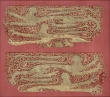
The Musée de Cluny in Paris houses a number of fragments of what probably was a horse trapper, produced in England in the early fourteenth century. Each of these fragments shows gold-coloured lions on a red velvet panel. The lions are surrounded by a multitude of small figures and imitation jewels.
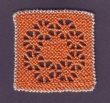
Puncetto is a knotted needle lace made with needle and thread, without a frame, and is worked back and forth, in rows. The technique originates from the Valsesia area in the North Italian Piedmont. Puncetto lace is characterised by its strictly geometric designs. In the late nineteenth century, it was promoted by the Anglo-Irish Mrs. Johnson-Lynch. It is also sometimes referred to as Punto Avorio ('ivory point').

The Muniment Room in Westminster Abbey houses a royal seal bag that is attached to a document dated to 26 November 1280, and used to protect a wax impression of the Great Seal of King Edward I of England (1239-1307, he reigned from 1272) The seal bag is made of wool with a linen lining, intarsia (inlaid) appliqué (with motifs surrounded by laid linen cord) for the main designs, and silk thread embroidery for the details. The embroidery is worked in split stitch.

The Victoria and Albert Museum in London houses various remains of a medieval orphrey, which were later used for five cushions or kneelers. These cushions derive from the St Leonard Church in Catworth, Cambridgeshire and were acquired by the Museum in 1902. The orphrey has been dated to between 1329 and 1354.

Queen Mary Psalter, now housed in the British Library, London, is named after the English Queen Mary, who obtained the Psalter in 1553. The Psalter contains many illuminations, one of which (MS Royal 2B VII f. 37v) shows, to the left, a woman working her embroidery on a rectangular frame. The drawing refers to the Biblical story of Gideon (Jerubbaal). The drawing, and the full manuscript, date to c. 1310-1320.

Eliza Matilda Johnson-Lynch, born in Ireland in 1846, played an important role in the promotion of Italian embroidery in the late nineteenth and early twentieth centuries. She was a great traveller, and very active in the women's rights movement.
More...

The Leviathan stitch is very similar to the double cross stitch. It is a composite stitch that combines a 'normal' cross stitch, worked first, with an upright cross stitch worked on top, creating a neat square. The stitch is also known as the Smyrna cross stitch or the railway stitch.

The double cross stitch is a composite stitch that combines an upright cross stitch with a 'normal' cross stitch that is worked on top. It is also known as the double straight cross stitch, and is worked almost in the same way as the Leviathan stitch (whereby the upright cross stitch is worked on top of the 'normal' cross stitch).