
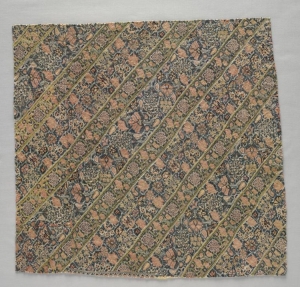
The Cleveland Museum of Art in Cleveland, Ohio, houses a panel that was probably meant for a pair of woman's trousers. The fragment measures 51 x 51 cm and is made with silk thread embroidery. The embroidery consists of diagonal bands in the Naqsh tradition.

The collection of the Cleveland Museum of Art in Cleveland, Ohio, includes a piece of fabric that was probably meant for a pair of woman's trousers. The fragment measures 65 x 51 cm and is made of a cotton ground material with silk thread embroidery in outline stitch. The embroidery consists of diagonal bands in the Naqsh tradition.
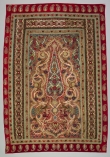
The Cleveland Museum of Art in Cleveland, Ohio, houses an Iranian prayer rug with inlay patchwork in the Rasht tradition. It measures 195 x 133 cm and is made of wool and woollen inlays, with silk thread embroidery worked in chain stitch. A large representation of a cypress tree occupies the centre of the rug, placed on top of peacocks and dragon heads.
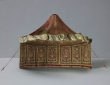
The Cleveland Museum of Art in Cleveland, Ohio, holds in its collection a ceremonial tent that is inscribed with the name of Muhammad Shah, the Qajar dynasty ruler of Iran between 1834 and 1848. The tent measures 360 x 400 cm, and the side panels reach to a height of 165 cm.
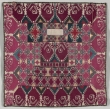
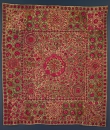
A relatively early suzani wall hanging or bed cover, dated to the early nineteenth century, is housed in the Cleveland Museum of Art, Cleveland, Ohio. It measures 217 x 189 cm. The cloth consists of separate pieces of ground material. The patterns were first drawn onto the cloth before being worked in chain stitch. Most suzanis are decorated with floral motifs; this piece is no exception. Overall, the embroidery on this suzani is remarkably dense.

The Cleveland Museum of Art, Cleveland, Ohio, has in its collection a woman's coat (chyrpy) that originates from the Tekke Turkmen in northeastern Iran / Turkmenistan, and approximately dates to the late nineteenth, early twentieth century. It measures 119 x 75 cm and is made of a silk ground material embroidered with stylised tulips worked in chain stitch. This type of coat has false sleeves and was worn over the head.

The Cleveland Museum of Art, USA, holds a prime example of an Uzbek man's coat made of a cotton ground material and embroidered in cross-stitch with silk thread. It measures 150 x 218 cm. The design of the embroidery was first drawn onto the coat, after which the coat was taken apart and the separate segments embroidered, after which the coat was sewn together again. The coat is lined with ikat cloth.

The Costume and Textile Museum in Jaipur forms part of the Maharaja Sawai Man Singh II Museum. The Museum itself is housed inside the City palace of the royal family of the rulers of Jaipur, the capital of the Indian state of Rajasthan.

The Clive Museum at Powis, Powys, Wales, houses an important collection of objects from India collected from the seventeenth to the nineteenth centuries by the Clive family, including Robert Clive and his son, Edward Clive.
More...

The Clive Museum at Powis is housed at Powis Castle, Powys, in the centre of Wales. It is now managed by the National Trust and includes a large collection of items collected in India dating from the seventeenth to the nineteenth centuries.
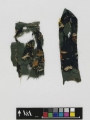
The Victoria and Albert Museum in London houses a collection of textiles that were recovered in 1907 by the British/Hungarian explorer Aurel Stein (1862-1943) from the caves of Dunhuang in western China. These include two related silk fragments of what may have been a Buddhist streamer.

Mojaris (also known as mozaris) are a form of traditional footwear from the Indian subcontinent. They are mostly made of tanned leather. The leather (or sometimes textile) uppers are characteristically decorated with embroidery, metal threads, pieces of glass, brass nails, cowry shells, etc. The uppers are generally connected to the soles with cotton thread.