

The cross stitch is a widely used technique, of ancient date, in the form of a simple, diagonal cross. It is normally classed as a counted thread form, because the stitch passes over two or more threads of the ground material.
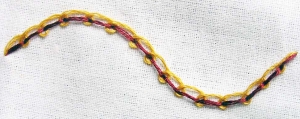
The Pekinese stitch is a decorative technique made up of two elements that are combined in order to create a looped effect. It is also known as the interlaced back stitch, but also sometimes as blind stitch.
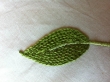
Filling stitch is a generic term for surface stitches that are used to fill in specific parts of a design or the grounding around a design. There is no one specific stitch known as a 'filling stitch'. Instead there are many stitches used for filling, including cross stitch, fishbone stitch, satin stitch and tent stitch.

The chevron stitch is an embroidery technique often used for lines and borders. It is worked in a similar manner to a herringbone stitch and on a double line.
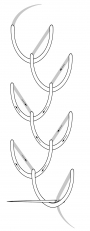
The feather stitch consists of a loop that is moved to the right and left of a central line. It is worked by a needle/thread being inserted slightly to the right of the main line of the pattern. The needle and thread are then pulled through to the surface along the line, keeping the rest of the thread under the needle in order to create a V-shape. A similar stitch is then made on the left hand side of the line and the stitch is repeated.

A basket stitch is an embroidery technique often used to cover large areas or, in particular, fill in large stems.
More...
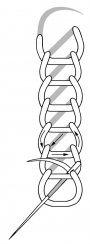
The open chain stitch is a form of chain stitch, but with a wide, ladder-like loop, rather than the normal oval shaped one. It is also known as the ladder stitch, Roman chain stitch, or the square chain stitch.

Petit point is a term sometimes used for canvas embroidery stitches that are worked on single thread canvas over one or two horizontal threads of the ground. In particular it refers to the use of tent stitch, half cross stitch and rep stitch. The term can be used to describe both the stitch used and the end product, such as a petit point bag.

A Byzantine stitch is a canvas embroidery stitch used to create the effect of brocaded or woven material. It consists of a satin stitchworked diagonally over four vertical and four horizontal threads of the canvas, thus creating a stepped pattern. It is often used to cover large surfaces.