
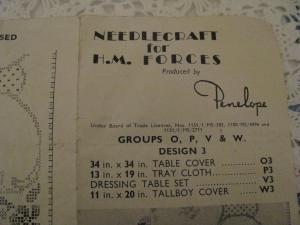
Needlecraft for H.M. Forces is the name for a series of small embroidery kits and booklets produced during the Second World War. They were made by the company of Wm. (William) Briggs and Co. Ltd. (34 Cannon Street, Manchester, England). The kits and booklets were specifically produced for wounded members of the British armed services.

Nakshi kantha is a form of kantha work, promoted among others by Surayia Rahman. Kantha quilts are traditionally made from layers of cloth salvaged from old saris and dhotis, although by the end of the twentieth century new cloth was also being used. Nakshi kanthas are often not quilted, but used as decorative wall hangings.
King's (Queen's) Embroiderer was an official position, from the late medieval period onwards, within the Great Wardrobe, a branch of the English monarch’s court.
Job's Tears is a tall, grain-bearing plant of the family Poaceae (grass family), a native of Southeast Asia. The seeds of this plant are used as a form of applied decoration. The plant flowers from July to October with the accessor fruit (pseudocarps) ripening from September to November. It grows in the open, preferably in moist soil at a high altitude.

The Jersey Occupation tapestry is a commemorative embroideryillustrating the occupation and liberation of Jersey, one of the British Channel Islands, from the Nazi’s during the Second World War (1939-1945). The Channel Islands were the only part of Britain to be occupied during the war. The embroidery was made to celebrate the fiftieth university of the island’s liberation. It is also known as the Occupation tapestry.

Java canvas work was a popular form of embroidery in the late nineteenth century, named after its ground material (Java canvas, aida). It was used for mats, music cases, work cases, and any article that requires a pliable, yet moderately stiff foundation (including slippers!). The embroidery was worked with wool, silk or filoselle silk threads.
Java canvas is a nineteenth century form of canvas, in which three or four warp threads and three or four weft threads are used in blocks, with a small gap between each block.
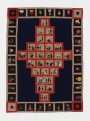
This is a form of patchwork whereby a design is cut out of two pieces of cloth, which are, generally, differently coloured. Each design cut out from one piece of cloth is sewn into the hole made by the other.
More...
The Hardwick Hall kantha quilt is an early example of Bengali (India) kantha work dating to the early seventeenth century, in the collection of Hardwick Hall (England).

Hamilton lace is a form of net lace or a loosely worked torchon lace (a form of bobbin lace), from Scotland, popular in the late eighteenth century, and allegedly introduced to Scotland by Lady Hamilton, born Elizabeth Gunning (c. 1733-1790).

Fontenoy embroidery (Broderie de Fontenoy-le-Château) is a form of whitework using chain stitch and a tambour hook. It is associated with the town of Fontenoy-le-Château in the Département of Vosges (northeastern France), which is particularly known for its production of embroidery from the late nineteenth century until the 1970's. At its peak the town employed some 500 women working on this form of embroidery.