

Flax is an upright, annual plant of the genus Linum (family Linaceae). The most widespread version of flax is Linum usitatissimum, which is native to a vast area extending from the eastern Mediterranean to India. The plant is cultivated either for its seed (linseed) or for its fibres.
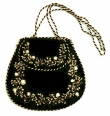
Fish scale embroidery is a technique that was popular in nineteenth century Britain. The fish scales usually came from carp, goldfish or perch, as their scales were regarded as the most iridescent. Fish scale embroidery was worked on silk, satin or velvet ground cloth and the scales were used to imitate flower petals, bird feathers and butterfly wings.

Fine d'Aubusson is a four-stranded Merino woollen thread made in France by the firm of La Route de la Laine for the retailers of Au Ver à Soie. It is basically a worsted thread rather than a springier tapestry or woollen yarn. Fine d’Aubusson can be used for a variety of crewel embroidery forms, as well as for fine work, such as tambour embroidery.
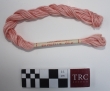
Filoselle silk is a silk yarn used in embroidery. It is made from filoselle, the portion of a silk cocoon that is not used for good quality silk cloth or yarn because the filaments are damaged or broken. Filoselle silk was introduced in Europe and North America in the 1850's.
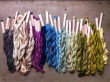
Filoselle is the portion of a silk cocoon that is not used for good quality silk cloth, because the filaments are damaged or broken. Filoselle is normally carded, spun and then plied to make silk yarns. Six-stranded filoselle silk embroidery thread became popular in the late nineteenth century for various types of embroidery.

Filo-floss silk thread is a trade name for a silk thread produced by the British company of Pearsall's (Filo-floss six-stranded embroidery thread).
Fancy-work is an eighteenth and nineteenth century English language term often used for embroidery.
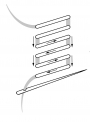
Economy stitch is a synonym for a one-sided satin stitch, whereby the embroidery thread is mainly used on the obverse of the cloth, rather than also covering the reverse as with the satin stitch. This stitch was chosen for economic purposes, since less thread is used than with the normal satin stitch.
More...

Embroidery canvas is an open-weave canvas, especially suitable for various types of decorative needlework, including counted thread embroidery. It has been used since the early seventeenth century and became especially popular in the nineteenth century with the advent of Berlin wool work.
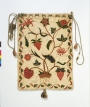
Embroidery is a late medieval English term derived from the French term ‘embrouder.’ By the sixteenth century the term ‘embroidery’ in English started to refer to rich materials that were embellished with stitches or decorated with appliqué. This form of work was generally free style in appearance. The person (male or female) who carried out this type of work was generally called an embroiderer.

Embroidered net is a type of net that is decorated with hand or machine embroidery. Some authors state that the net has to be machine made (Earnshaw 1988:53), while other authors say that either a hand or machine net can be used.

From the sixteenth century, the city of Delft in the Netherlands was famous for the production of tin-glazed earthenware, especially tiles, which were exported throughout the world. Many of these objects had simple blue on white designs that were later used as a source of embroidery patterns. In the USA, these patterns became known as Delft embroidery.