
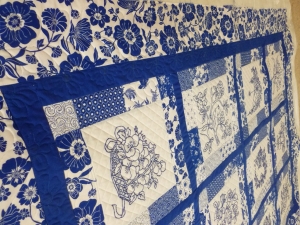
Bluework is the term for any form of Western decorative needlework that is exclusively worked in a blue thread on a white or natural coloured ground. This style of embroidery became popular in the late nineteenth and early twentieth centuries. There was also a resurgence in its popularity at the end of the twentieth century.

Aleppo embroidery is a form of monochrome counted thread embroidery associated with the Aleppo region in Syria. During the first half of the twentieth century, many Arab girls made garments for their future husband, which were to be worn by the grooms during the wedding ceremonies. These garments were intended to show off the embroidery skills of the bride to her future husband and his family.
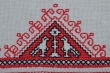
Assisi embroidery is a form of counted thread work. It is characterised by a background filled with embroidery stitches and the main motifs left as voids (see negative design), without stitching. The background stitches include cross stitch, herringbone stitch and long and short cross stitch. The main motifs are often outlined with stem stitch.
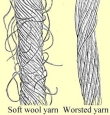
Yarn is a general term for a thread. It applies to single (often in US English) and (more generally) plied forms.


Woad (Isatis tinctoria) is a flowering plant of the Brassicaceae family. It is commonly known as dyer’s woad or simply, woad. It is also the name of a blue dye produced by the leaves of the plant. The woad plant is native from the steppes and desert zones of Central Asia as far as the Caucasus, but is now also found throughout Europe.

The Wemyss School of Needlework was a hand embroidery school based in Wemyss Castle, Fife, Scotland. It was founded in 1877 by Dora Wemyss, who was inspired by the Kensington School of Art Needlework, later known as the Royal School of Needlework.

Weld (Reseda Luteola) is a native Eurasian plant of the genus Reseda, commonly known as dyer’s rocket, dyer’s weed or yellow weed. It is also the name of a yellow dye produced by the leaves of the plant. It is rich in luteolin, a flavonoid that produces a bright yellow dye.
More...

Thread count is the number of warp threads (ends) or weft threads (picks) per unit of measurement (for instance centimetres).