

Drawn thread work is a form of embroidery, by which selected warp and/or weft threads are drawn out of the ground material and then cut off. The raw edges are normally stitched over. The remaining threads are decorated with buttonhole stitch or other stitches, in a variety of designs. In Italy it is known as punto tirato.

Thérèse de Dillmont (1846-1890) was an Austrian embroideress, designer and writer, who grew up in Vienna and became famous for her association with the firm of DMC in Mulhouse. She trained as a governess and a teacher, an upbringing that included embroidery. During her time in Vienna and afterwards, she was in contact with Mrs Emilie Bach, the director of the Imperial and Royal School of Art Embroidery.
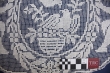
Darned netting or darned net (work) is a form of decoration, made with a needle, with a darning stitch, linen stitch or running stitch. It is applied on a knotted (filet), woven (buratto) or machine-made (net) ground, to form a geometric or figurative design. Various forms of darned net work are also sometimes called guipure d'art or filet lace.

Andrew Crummy is a Scottish artist, born in Edinburgh in 1959, who designed the panels for several commemorative embroideries. These include the Prestonpans tapestry (2010), Great Tapestry of Scotland (2013) and the Scottish Diaspora tapestry (2014).

Cretonne appliqué is a form of appliqué using pieces of chintz (in this context also called cretonne), which is a cotton or linen cloth with printed patterns, usually with large floral motifs. The pieces may be applied to different types of background. This type of appliqué was popular in North America during the latter half of the nineteenth century.
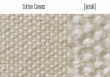
Cotton canvas is a nineteenth century term for a very fine canvas produced in Britain, France and Germany for Berlin wool work and comparable forms of embroidery. Both limp and stiffened forms were available. The French was regarded as the best, while the German version was seen as inferior. Often every tenth thread of the German cotton canvas was dyed yellow.

Cotton is a vegetable seed fibre consisting of ‘hairs’ attached to the cotton seed in its boll (protective capsule). Cotton comes from several plants of the Gossypium species (family Malvaceae). Cotton fibres are normally soft and fluffy and vary in length from 1.5 to 5 cm. The normal colour of cotton is light to dark cream, although it may be brown or green depending upon the plant variety, the weather and the soil conditions.

James Fenimore Cooper was a prolific American author, most famous for his novel The Last of the Mohicans, which was published in 1826. In his Autobiography of a Pocket Handkerchief, which is a short novel first written for a magazine in 1843, he follows the life of a decorative linen handkerchief.

A commemorative quilt is especially made to mark a personal, family or institutional event or situation. These quilts may be made by individuals or groups. Some commemorative quilts are purely decorative, others have names, dates and/or inscriptions.

A commemorative embroidery is especially made to mark a personal, family or institutional event or situation. Commemorative embroideries can take the form of a single panel, such as a commemorative sampler, small memorial cards, or large-scale panels that may be many metres long.
More...

Coggeshall is a town in Essex (England) noted for its tambour embroidery on net, called Coggeshall lace or Coggeshall tambour lace, and sometimes Coggeshall embroidery. The industry was started around 1812, when a French (or possibly Walloon) refugee called M. Draygo (also written Drago) and his two daughters came to Coggeshall.

By the sixteenth and seventeenth centuries, the Cloth of State in England was a set consisting of a canopy (called a ceeler) and a long back (tester) hung against the wall. The set hung above and behind the monarch's throne. It was often made of very rich damask, brocade or velvet cloth and embroidered with armorial (such as a coat-of-arms) designs.
Check canvas is a form of canvas, in which the warp threads are worked in three sets of two threads, and the weft threads are worked in three sets of four threads. GVE
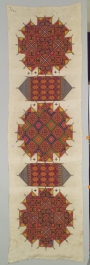
Chefchaouen embroidery derives from a city with the same name, which is located in the Rif mountains of northern Morocco. Founded in 1471, the city soon became home to Jewish and Muslim exiles fleeing the Spanish Reconquista. The embroidery traditions of the various religious and ethnic groups all affected later Chefchaouen production.