

Cennino d'Andrea Cennini was an Italian painter who also produced patterns for embroidery and lace. He is most famous for his book, Il libro dell’Arte, which includes details of various painting techniques then in current use.

The Casdagli sampler is a form of trench art worked in 1941 by a British army officer, Major Alexis Casdagli. He was captured and imprisoned by the German forces early in the Second World War (1939-1945). After six months in a German Prisoner of War (POW) camp, Casdagli was given some embroidery canvas.

Calico is originally a cotton cloth imported from the East (India). It is named after the Indian city of Kozhikode (Kerala State; known by the English as Calicut) in southwestern India. From about 1578 onwards the word calico has come to mean, in England, a plain white unprinted, and unbleached cotton cloth. It may contain un-separated husk parts.
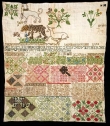
Jane Bostocke's sampler is the earliest surviving British example of this type of embroidery. The sampler was worked by Jane Bostocke of Langley (Shropshire, England) and includes the date 1598. The sampler was made to commemorate the birth of her cousin, Alice Lee, two years previously.
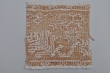
Buratto embroidery is named after buratto cloth, which in its turn is named after buratto, an Italian word for a sieve or sifter. Buratto embroidery is worked on an open, even-weave cloth (buratto cloth) with a single warp and a double weft. The ground has a square mesh (see lacis). Designs are worked in running stitch and may be counted or drawn directly onto the net. Buratto embroidery can be classed as an embroidered lace.
Buratto cloth is named after buratto, which is an Italian word for a sieve or sifter.

Officially known as the Worshipful Company of Broderers, the Broderers' Company is one of the Livery Companies of the City of London. The Company is also known as the Brotherhood of the Holy Ghost of the City of London. The term broderers refers to male workers in embroidery.

In 2014 it was announced that a new commemorative embroidery had been designed by the Westcountry (UK) artist, Tom Mor (who also designed the Plymouth tapestry and the New World tapestry). The Bristol Berkeley Plantation tapestry is a single panel with various scenes that illustrate the establishment of the Berkeley Hundred Plantation in Virginia, USA.
Breton work is a form of embroidery that was popular in the 1870's and 1880's in Northern Europe and North America. Breton work uses a machine-made net. It is thus sometimes classed as a form of embroidered net lace. Its name is derived from traditional Breton embroidery (France), which was often used on both men and women’s regional dress.

Brazilian dimensional embroidery is a textured surface embroidery. It uses rayon, Z-twisted threads of different weights and amounts of metal twists, as well as a variety of colours, to construct three-dimensional designs that are sewn onto a piece of cloth. Details are embroidered directly onto the cloth.
More...

The Bradford Table Carpet is a special canvas embroidery from the early seventeenth century (c. 1600-1615). Although it is called a carpet, it is a table covering. A 'table carpet’, such as this example, was removed or covered with a linen cloth when the table was in use. The Bradford example was originally owned by the Earls of Bradford at Castle Bromwich Hall (West Midlands, England).

A bracteate is a thin, metal (especially gold) disc or shaped form, which is sewn onto a textile or item of clothing. A bracteate is normally small, only a few centimetres in diameter. A bracteate can be very simple, or highly embellished with other materials, sich as beads, gems, or (enamelled) glass.

Biscornu (biscournu) is the name for a small, eight-sided pin cushion that became popular in the first decade of the twenty-first century. The word biscornu is derived from the French adjective biscornu, meaning irregular, skewed or strange.
