

Jess de Wahls (1983) is a textile artist and embroiderer who was born in (communist) East Berlin, and moved to the UK in 2004. She has set up a commercial line in embroidered flower patches that can be ironed onto T-shirts and other garments, and which are sold, among others, by Liberty of London.

Between 3 March and 18 July 2021, the Fries Museum in Leeuwarden, the Netherlands, presented a large exhibition with the title Haute Bordure. The curator was Eveline Hoisappel. Unfortunately, because of the corona pandemic the exhibition could only be seen by the public from early June.
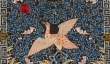
Stitch is International is the title of an exhibition that was due to open in 2020, but postponed because of the corona pandemic. The exhibition shows unique examples of needlework from the collection of the Royal School of Needlework at Hampton Court, UK.
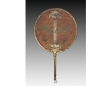
In 2020, the Cleveland Museum of Art (CMA), in collaboration with the Seoul Museum of Craft Art, set up an exhibition with the title: Gold Needles: Embroidery Arts from Korea. The exhibition focuses on the embroidery produced in the later years of the Joseon Dynasty (1392-1910). The description below is taken from an accompanying text written by Sooa Im McCormick, associate curator of Korean Art at the CMA.
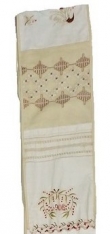
The Textile Research Centre in Leiden has a number of long samplers called, in Dutch, a pronkstuk or pronkrol. This particular example (TRC 2020.3535a) is almost 9 m long and 30 cm wide. long and 40 m wide. It shows a wide variety of embroidery techniques.
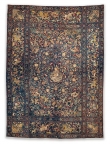
Colcha is the Portuguese term for what in the English language is called a Bengalla, Hooghly, Satgaon or Indo-Portuguese quilt. They are textiles of some 2.5 by 3 m and produced in Bengal, northeastern India, and in western parts of the Indian subcontinent, mainly for the European (Portuguese) market from the early sixteenth to the mid-seveneteenth century.

Satgaon quilts are named after the settlement with the same name, modern Saptagram, in northeastern India, just north of Calcutta/Kolkota. In historical times it was a major port, but lost its position following the silting up of the Saraswati river. Its abandonment contributed to the growth of nearby Hooghly/Hugli and, later, Calcutta. Satgaon was an important trading centre for the Portuguese in the sixteenth century. It was known to them as Porto Pequeno ('Little Harbour').
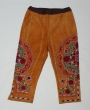
The Textile Research Centre in Leiden has a pair of 1960s embroidered breeches from Afghanistan that were worn by wrestlers in a zurkhane (TRC 2016.1772).

In July 2017 the London-based embroidery firm of Hand & Lock organised the exhibition "250 Years of Embroidery."

The Metropolitan Museum of Art in New York has an early seventeenth century sample book from Portugal (MMA 25.92). It is filled with numerous small pieces of actual embroidery worked on a linen ground using silk yarns in various colours.
More...
Hainault lace is named after the Belgian province of Hainault (Henegouwen). Hainaught lace was produced in the late nineteenth and early twentieth century and resembles coarse forms of Bedfordshire lace, itself a development of Genoese and Maltese lace forms. It is characterised by the so-called wheatears.

Maltese lace is a form of guipure bobbin lace that was introduced in the early nineteenth century by Genoese lace makers to the Mediterranean archipelago of Malta, and in particular to the island of Gozo. It is normally made of an ecru coloured, silk yarn, with the Maltese cross as a characteristic element in the design. Black samples are also made, and especially from the late nineteenth century Maltese lace is often made of linen.

Yak lace is a form of guipure (bobbin) lace. It was made in England in imitation of Maltese and Greek laces. It was generally made of woollen yarns (certainly not exclusively yak). It became popular from the mid-nineteenth century. For guipure laces, see also Genoese lace, Bedfordshire lace, Cluny lace and Maltese lace.
The Textile Research Centre in Leiden has a so-called pronkstuk or pronkrol. It is a long sampler of some 7.5 m long and 40 m wide, showing a wide variety of embroidery techniques and some miniature garments.