
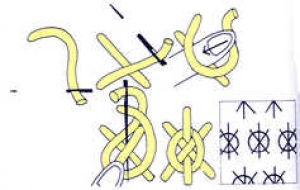
The cross and twist stitch is a composite stitch that is worked by creating a cross stitch followed by a vertical straight stitch that pierces the ground material at the top and bottom of the cross stitch, and the thread is looped around the cross stitch in the centre, thus making a twisted chain stitch with a long tail. Also known as the moss stitch.

The crested chain stitch is a composite stitch that combines a chain stitch and a coral stitch. It is used to make a broad, decorative braided band.
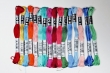
Coton à broder is a 3-ply mercerised, tightly twisted cotton thread used for embroidery.

The continental tent stitch is a variation of the tent stitch, whereby the diagonals at the back are longer than those at the front.

The colonial knot is a variation of the French knot. With the French knot, the thread is simply twisted twice around the needle before it is inserted into the fabric; with the colonial knot, the thread is twisted in a form of '8'.

The coil filling stitch is a composite stitch often used in drawn thread work. It is created from right to left, with three satin stitches worked over four horizontal threads, and between two vertical threads. Four threads are left between each coil.

The cloud filling stitch was traditionally used to fill motifs in crewel work. It is generally carried out in two different colours.
More...

The closed feather stitch is worked from top to bottom and can be used as a border. It basically is a feather stitch, in which the 'V's are brought together, creating a ladder-like appearance. It is often created by first drawing two parallel lines from top to bottom.

Piccadill (peckadill, pickadill, picardillo, pickadaille) was the name of a type of sixteenth-century cut-work lace, characterised by its very small spear-points. The name was also applied to the lace edge of a ruff, and hence to the full ruff itself. The name reputedly derives from Spanish picado, which means punctured or pierced. A ruff was correspondingly called a picadura in Spanish.

In the closed buttonhole stitch the legs are placed in a diagonal, rather than straight line as with the 'normal' buttonhole stitch, creating a line of triangles along a straight line.

Arrasene is a silk or wool thread, often regarded as a form of chenille, which is used for embroidery, including Arrasene work. The name is derived from that of the northern French town of Arras (Dutch: Atrecht), which was an ancient textile centre.