

The Nederlands Openluchtmuseum in Arnhem, houses an embroidered bodice from the island of Marken, in the former Zuiderzee, now the IJsselmeer. Locally it is called a bruidsrijglijf. It is made of silk and embroidered with silk. The red band along the bottom is made of wool. Small bustle-style cushions were suspended from this band to broaden the apperance of the hips.

The Nederlands Openluchtmuseum in Arnhem, houses an embroidered bodice from Zeeland, in the southwest of the country. Locally called a beuk, and more nationally called a kraplap, this type of garment consists of two panels sewn together along one side with an opening in the centre for the head. The beuk is made of linen and embroidered in cross stitch with silk. Cotton is used for the sewing.
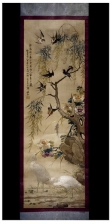
The Victoria and Albert Museum in London houses an embroidered scroll painting from China, which dates to the third quarter of the nineteenth century. It is made of silk and embroidered with silk thread, and measures 160 x 43 cm. The embroidery shows a willow tree, kingfishers and swallows.
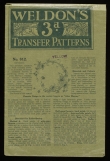
The Victoria and Albert Museum in London houses the packaging of an embroidery design published by Weldon's Ltd. It dates to the early twentieth century and measures 13.9 x 21.2 cm. This is Weldon's design No. 812, of the Clematis, and its variety known as "John Murray".
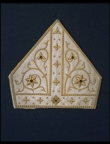
The Victoria and Albert Museum in London houses a gold-embroidered mitre, made of silk and further decorated with gemstones, which was designed by Augustus W.N. Pugin (1812-1852) around 1848-1850, for the St. Augustine's Abbey, which Pugin had built on the grounds of his own house in Ramsgate. The mitre was probably produced by the firm of Lonsdale and Tylor.
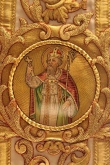
The Basilica of Our Lady in Hanswijk, Mechelen, Belgium, houses an embroidered representation of St. Rumbold. The embroidery is worked in the or nué technique that was popular in the Netherlands in the fifteenth and sixteenth centuries. The embroidery is attached to a chasuble.

The Rijksmuseum in Amsterdam houses an English sampler worked by Mary Lane and dated 1766, which refers to two English eighteenth century songs, namely "Since all the downward tracts..." and "Since none can doubt...." The sampler is made of linen with silk thread embroidery. It measures 41.5 x 35.5 cm.

The Rijksmuseum in Amsterdam houses a medieval Egyptian textile fragment with embroidered decoration. The ground material is linen, the embroidery is carried out in silk, with pulled thread work, double running stitch and satin stitch. The fragment dates to the late medieval, Mamluk period. It measures 28 x 10 cm.
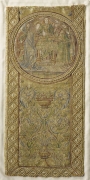
The Rijksmuseum in Amsterdam holds a fragment of an orphrey (Dutch: aurifries). It measures 46.5 x 21.5 cm and it is richly embroidered in the or nué technique that was very popular in The Netherlands and beyond in the fifteenth and sixteenth centuries. The embroidery is worked with silk and gold thread. The medallion in the centre shows the Presentation of Jesus at the Temple.

The Metropolitan Museum of Art in New York houses a small fragment of Chinese embroidery that shows two confronted birds. The fragment measures 31.1 x 36.8 cm and is worked in silk on a silk ground material. It is dated to the early eighth century. The pattern with the two opposed birds was popular in the early Tang period (Tang Dynasty: 618-907).
More...

'The Baptism of Christ' is an embroidered picture, which originally may have been attached to a larger textile, as for instance an altar frontal or ecclesiastical vestment. It was made in the (southern) Netherlands around AD 1500, in the or nué technique, with silk and metal thread embroidery. It measures 38.7 x 44 cm.

'David and Abigail' is an embroidered picture made in England in the mid-seventeenth century, now in the Metropolitan Museum of Art, New York. It may originally have been a cushion cover. The ground material is linen, and the embroidery is carried out with silk thread. It measures 48.3 x 62.2 cm. The central scene shows David on his horse, talking with Abigail in front of him (compare I Samuel 25).

'The Empress and Porphyrius visit St. Catherine in Prison' is an embroidered picture in the shape of a roundel, which originally may have been attached to a larger textile, as for instance an altar frontal or ecclesiastical vestment. It was made in the (southern) Netherlands around AD 1430, in the or nué technique, with silk and metal thread on linen. It measures 16.5 cm in diameter.

'The Annunciation' is an embroidered picture with a representation of the Archangel Gabriel announcing to the Virgin Mary the forthcoming birth of Christ with the words: Ave Maria gratia plena dominus tecum (Luke 1:28). It was made in the (southern) Netherlands around AD 1450, in the or nué technique, with silk and metal thread on linen. It measures 21 x 9.5 cm.