

The Victoria and Albert Museum in London houses an embroidered picture of Napoleon Bonaparte, which was made by Mary Linwood (1755-1845) in 1825. The technique she used was needlepainting, whereby oil paintings and other representations were exactly copied with hand embroidery, against a painted background. The embroidery measures 78.3 x 71.2 cm and was carried out in crewel wool on a wool ground.
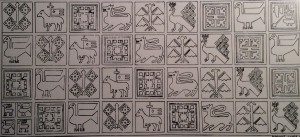
The tomb of Walter de Gray, Archbishop of York from 1215-1255, and one of those present at the signing of the Magna Carta in June 1215, is located in the south transept of York Minster.
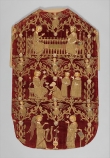
The so-called Chichester-Constable chasuble is now housed in the Metropolitan Museum of Art, New York. It was made in England, in the opus anglicanum tradition, in the mid-fourteenth century. It measures 129.5 x 76.2 cm. It used to be larger, but was cut to its present (fiddle) shape in the sixteenth century to conform to contemporary fashion. Some of the off-cuts were used to make a stole and a maniple.

Cloth of gold was an extremely expensive fabric produced at different periods and in different parts of the world, but especially known from late medieval Europe, and produced particularly in northern Italy. It is characterised by gold (or sometimes silver) threads (normally passing) woven into a precious, often a silk fabric, creating a stiff and heavy (and very expensive) material.

An amice (Latin: amictum) is a liturgical garment worn mainly in the Western Catholic Church and in some of the Protestant Churches. It is a separate, rectangular piece of linen worn across the shoulders and fastened around the back and waist. It is normally made of a plain fabric, but it sometimes has embroidered decoration.
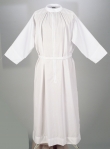
The alb (Latin albus, 'white') is an ecclesiastical vestment of some of the Western Churches, including the Anglicans, Lutherans, Methodists and Roman Catholics. It is used by all levels of the Catholic clergy. It is generally worn over the cassock, and under the chasuble or dalmatic and is usually girdled with a cincture. It derives from the Roman-period, long-sleeved tunica alba, which in the Roman Empire was worn by the well-to-do.

This large and monumental embroidery on canvas is worked in wool and silk. It is based on a woodcut, dated 1547, by the German artist, David Kandel of Strasbourg (c. 1520 - c. 1596). The techniques that are used are the cross stitch and tent stitch. It measures 280 x 388.9 cm.

A panel (20.3 x 15.9 cm) with embroidery carried out in the or nué tradition, popular in the Netherlands in the fifteenth and sixteenth centuries, is housed in the Metropolitan Museum of Art in New York. It dates to the early fifteenth century and represents the medieval story of Saint Martin and the Repentant Horsemen. The embroidery is worked in silk and silver thread on a linen background.

The Victoria and Albert Museum in London houses a chair seat that is embroidered in wool and some silk on a canvas ground material in tent stitch, using counted thread work. It dates to the first half of the eighteenth century and was made in England. It measures about 55 x 65 cm.
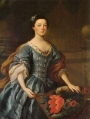
Lady Jane Allgood (1721-1778) of Nunwick Hall, Northumberland, England, is portrayed with a large embroidery of tulips and anenomes, reportedly intended for some chairs and screens at the estate. The chairs and screens with the embroideries are apparently still at Nunwick Hall.
More...

The Victoria and Albert Museum in London houses an embroidered picture illustrating 'Mary Queen of Scots mourning the dying Douglas at the Battle of Langside'. The embroidery is based on an oil painting by Charles Landseer (1799-1879). The battle was fought on 13th May 1568, and the defeat of Mary's loyal forces led her to flee from Scotland to England (and to her subsequent imprisonment by Elizabeth I).

Edgitha (Ealdgyth; Edith of Wessex; c. 1025 - 1075) was the wife of (Saint) Edward the Confessor (c. 1042-1066) and the sister of King Harold II, who died at Hastings in 1066. She appears to have been an accomplished embroideress.

The Battle of Maldon was fought in 991 near Maldon, Essex, England, between Earl Byrhtnoth and his Anglo-Saxon forces, and an invading army of Danes. The Anglo-Saxon king at the time was King Æthelred the Unready. When the Anglo-Saxons were defeated, they were forced to pay a high sum to the Scandinavians, heralding a long period of regular payments to the Danes.
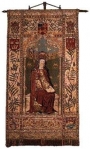
The Etheldreda Banner was worked in 1910 by Miss Yams of Bayswater. St. Etheldreda (Æthelthryd, or Audrey) was the daughter of King Anna of East Anglia. She founded the abbey church of Ely in 672. She died in c. 680 from a tumour in the neck; after that, on St. Audrey's day (23 June), (cheap) lace necklaces were sold (Saint St. Audrey's lace), hence the word 'tawdry'. The banner is still used during processions at Ely Cathedral.