
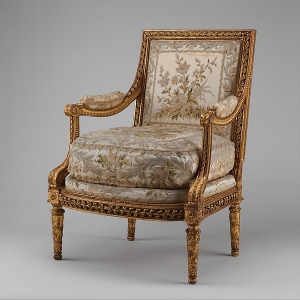
In the collection of the Metropolitan Museum of Art, New York, there is an embroidered formal chair that dates to the eighteenth century and was made and used in France. It was manufactured by the famous craftsman, Georges Jacob (1739-1814), and the chair's embroideries were made, so it would appear, by Joseph-François-Xavier Baudoin (1739-c. 1786).

The Metropolitan Museum of Art houses an eighteenth century, American-made adjustable embroidery frame, designed to be placed on the floor, leaving the hands free to work the embroidery. It is made of mahogany and cherry wood and measures 139.7 x 105.4 cm.
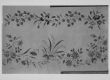
The Metropolitan Museum of Art in New York holds a copy of the first and second volumes of the Zeichen-Mahler und Stickerbuch zur Selbstbelehrung für Damen welche sich mit diesen Künsten beschäftigen, by Johann Friedrich Netto (1756-1810). The first volume was published in Leipzig in 1795 (acc. no. 25.65.4); the second in 1798 (acc. no. 32.121.3), and the third in 1800.
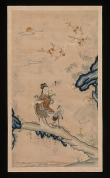
'Painting with Threads: Chinese Tapestry and Embroidery, 12th–19th Century' was the title of a small exhibition (called installation in American parlance) displaying a small selection from the Museum holdings of Chinese tapestries and embroideries. The exhibition ran from late 2014 to the summer of 2015.
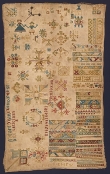
In 2015-2016, the Metropolitan Museum of Art in New York organised an exhibition called 'American and European Embroidered Samplers, 1600-1900'. The exhibition showed a selection of some thirty examples from the total of some eight hundred samplers housed in the Museum.
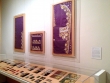
The Metropolitan Museum of Art in New York mounted an exhibition in 2015 that focussed on the highly decorative upper class men's wear in France in the late eighteenth and early nineteenth centuries. It showed long lengths of cloth woven for a man's outfit, but never cut and sewn together. The exhibition included samples of embroidery for men's garments, worked between 1760 and 1815, mainly from France.

The Metropolitan Museum of Art in New York houses a page from an album of embroidery designs that originates from The Netherlands and dates to the early seventeenth century. The design is executed with pen and ink, with some wash. The design is unfinished.

The oil on canvas 'Women Working on Pillow Lace' (also known as 'The Sewing School') was painted by the Italian artist, Giacomo Ceruti (1698-1767). It is one of many paintings and drawings with the same theme, made in the late seventeenth and early eighteenth centuries. A sewing school was a popular theme, allegedly developed by the Danish artist, Bernhard Keil (1624-1687), who worked and travelled widely in northern Italy.

The oil on canvas 'A Lacemaker, with a Boy Blowing Bubbles' (De Kantwerkster / Kantklossende Vrouw en Bellenblazende Jongen) was painted in 1742 by the Dutch eighteenth century master, Louis de Moni (1698-1771). It is now part of the Mauritshuis collection in The Hague, and on long-term loan to the Museum De Lakenhal, Leiden, the town where De Moni eventually settled and spent the rest of his life.

This oil on canvas painting from 1776 by the Dutch artist, Hermanus Numan (1744-1820), shows Susanna van Collen-Mogge and her daughter, Johanna Ferdinanda (1774-1833). The painting measures 80 × 64 cm. The woman is shown making bobbin lace using a flat pillow resting on a support of some kind. There is a sewing box on the table.
More...
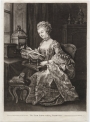
The Fair Lady Working Her Tambour is the title of a mezzo print dating to about 1764. It shows a woman at her tambour embroidery and behind her tambour frame, holding a tambour hook in her right hand.

'The Ladies Waldegrave' was painted by Sir Joshua Reynolds (1723-1792) in 1780. Now in the Scottish National Gallery, it shows the three daughters of the 2nd Earl Waldegrave (1715-1763) together working their embroidery. The painting, without the frame, measures 143 x 168.30 cm.
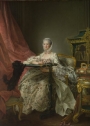
'Madame de Pompadour at her Tambour Frame' is an oil on canvas painting by François-Hubert Drouais (1727-1775), now housed in the National Gallery, London. Drouais was the main portrait painter at the court of Louis XV. He made this painting of Madame de Pompadour in 1763/4 and completed it after her death in the spring of 1764.

'The Embroidery Workshop' is an oil painting by Pietro Longhi (1701/2-1785; aka Pietro Falca), now in the Museo Correr in Venice. It shows a group of women being engaged in various activities related to embroidery.