

Komezashi
Komezashi is the Japanese term for the rice stitch, used among others for Shonai sashiko. WV
Field of the Cloth of Gold
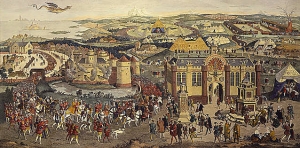
The famous Tournament of the so-called 'Field of Cloth of Gold' (in French: Le Camp du Drap d'Ort) took place in 1520 in the northwest of France and marked a meeting between Henry VIII of England and Francis I of France. The site was named after the tents and costumes splendidly decorated with cloth of gold, a type of fabric normally woven with a silver gilt weft thread.
Göss Chasuble
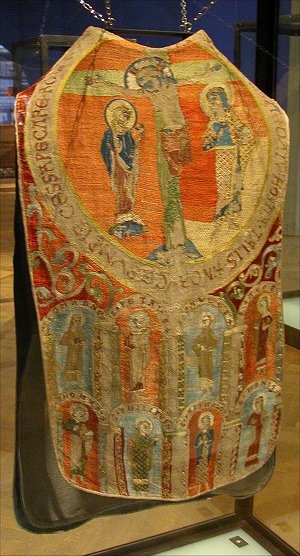
The so-called Göss chasuble is a thirteenth century silk garment now housed in the Museum für Angewandte Kunst in Vienna, but originating from the former Benedictine abbey/convent of Göss (Stift Göss), in Styria, Austria. The convent itself was closed in 1782. This vestment and other pieces from the Abbey are generally ascribed to the Abbess Kunegunde (1265-1321) and were to be worn by priest, deacon and sub-deacon.
London Embroidery School

The London Embroidery School is a subsidiary of the embroidery company of Hawthorne & Heaney,. The School organises classes and weekend workshops, and sells all sorts of embroidery materials. The School is located at Hawthorne & Heaney, 59 Brewer Street, Soho, London W1F 9UN.
Lier Centre for Textile Arts
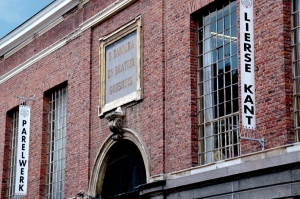
The Lier Centre for Textile Arts (Liers Centrum voor Textiele Kunsten) is established in the former chapel of the St Barbara and St Beatrice almshouse.
WW II Internment Camp Apron

The Rijksmuseum in Amsterdam holds an embroidered apron that was worked by Mrs Maria Christina Coppoolse (acc. no. NG-1999-18-A). The embroidery includes the texts, in the left upper corner: 'KRAMAT KAMP BATAVIA / 1943 - 1945' and in the right upper corner: 'Perlindoengan Tjihapit Bandoeng/ 2604-1944'.
Indo-Portuguese Smock

Indian craftsmen, especially from Bengal, were allegedly introduced to Portugal from the sixteenth century. The Victoria and Albert Museum, London, has a linen smock from Portugal dating to the first half of the seventeenth century and produced in the so-called Indo-Portuguese style, perhaps by Indian embroiderers living in Portugal.
Johanna Le Maire's Embroidered Gloves, 1622
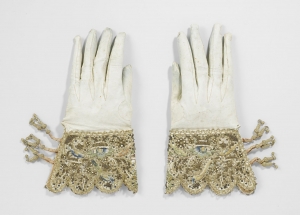
The collection of the Rijksmuseum in Amsterdam includes a pair of early seventeenth century embroidered gloves for a bride (acc. no. BK-1978-48-A). They are made of waxed leather, decorated with silk, lace, gold thread and paillettes.
Borduurder ('Embroiderer'), 1694

A print (14 x 8.1 cm) now in the collection of the Rijksmuseum, Amsterdam (RP-P-OB-44.538), shows a Borduurder ('embroiderer') hard at work. The print (an engraving), after a copper plate etching, forms part of a collection of one hunded representations of human occupation, called Spiegel van het Menselyk Bedryf, composed in the late seventeenth century by Jan and Caspar Luyken and published in Amsterdam in 1694.
Melk Chasuble
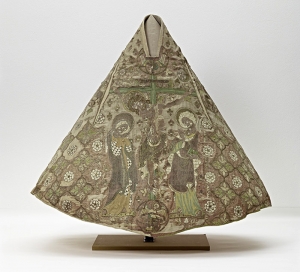
The Melk chasuble is a prime example of opus anglicanum, which was a famous technique practised in England in the thirteenth and fourteenth centuries. The chasuble is now housed in the Museum für angewandte Kunst in Vienna, Austria. It dates to about AD 1300 and measures 116.8 x 487.7 cm. It retains its original bell-shaped form. The arm-holes were cut out later. The colours are somewhat faded.