

Salé Embroidery (Morocco)

Salé is the twin town of Rabat, Morocco, situated on the opposite shore of the river Bou Regreg. The town was founded in the twelfth century AD. It developed commercial links with various Mediterranean and West European trading countries, including Italy, Spain, England and the Netherlands. From the eighteenth century onwards Salé became known for the production of embroideries, and in particular three main forms:
Ringgold, Faith (1930)

Faith Ringgold (1930) is an African-American quilt artist, born Faith Willi Jones in Harlem, New York City (USA). Ringgold’s oil paintings and posters, made at the beginning of her career, began attracting critical attention in the 1960's. In the 1970's she began painting on stretched canvas that she decorated with complex fabric borders.
Ojibwe Applied Decoration
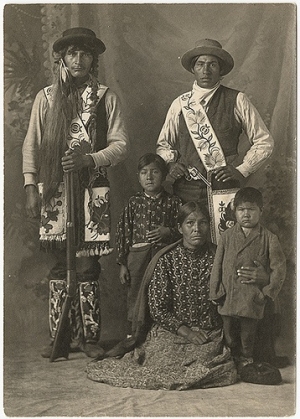
The Ojibwe are a North American Indian people now concentrated around the Great Lakes. Before European colonisation, traditional Ojibwe garments were made of tanned deerskin and decorated with applied items, including animal teeth, bone, pieces of copper and shells. Clothing and other objects were sometimes decorated with dyed porcupine quills or moose hair. Designs were mostly abstract and geometrical.
Jingle Dress
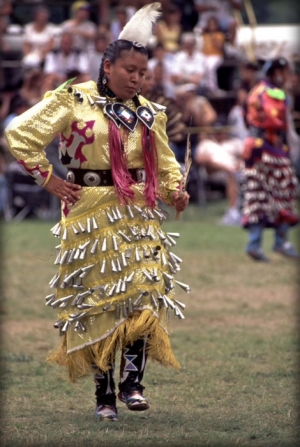
A jingle dress is a North American Indian woman’s garment decorated with multiple rows of hollow metal cones. The dress originated among Ojibwe communities in the Great Lakes region (USA). While Ojibwe women wore sashes in the late 1800's decorated with metal cones, the jingle dress first appeared in the 1920's.
Moffat, Alistair (1950)

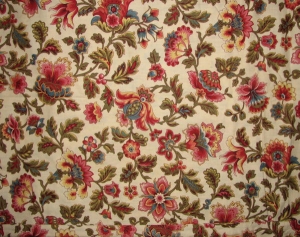
Alistair Moffat is a journalist, writer, former director of the Edinburgh Festival Fringe and Rector of the University of St. Andrews. Moffat was also co-chairman and historian for the Great Tapestry of Scotland, a community arts project that depicts the history of Scotland. The embroidery was unveiled in 2013 in the Scottish Parliament.
Petites Mains
Petites mains is a French term that literally means ‘tiny hands'. The term refers to ateliers and individual artisans that supply large haute couture houses, such as Chanel, Dior, Hermes and Lacroix, with various handicraft items. They are also known as fournisseurs. The petites mains include button makers, embroiderers, feather workers, flower makers, glove makers, milliners, etc.
Clabburn, Pamela (1914-2010)

Pamela Clabburn was an English museum curator and writer about textiles, including decorative needlework. She was particularly interested in Norwich shawls, because of family connections with the production of this form of clothing accessory.
Sampler Kit
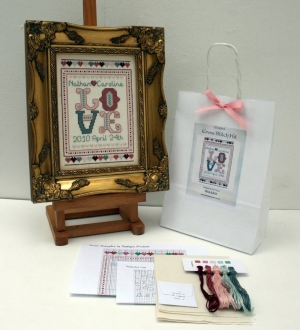
During the twentieth century, a number of companies in various countries produced kits with all the necessary materials needed to make a sampler of some form. These kits included ground material, thread, needle and a suitable pattern, usually in the form of a chart.
Private Thomas Walker, by Thomas Wood
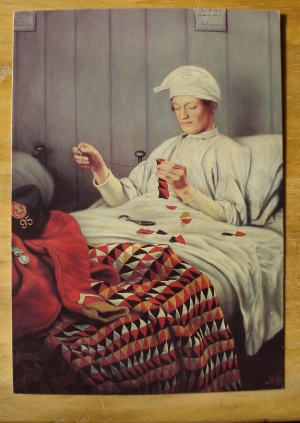
A painting by Thomas William Wood, exhibited at the Royal Academy, London in 1855, shows private Thomas Walker (95th Derbyshire regiment), sewing a so-called military quilt. He had been wounded at the battle of Inkerman in the Crimean War, on 5 November 1854. In the painting, Walker is sewing triangles made from woollen uniform cloth, in black, gold, red and white, creating a simple geometric design.