

Queen Arnegundis
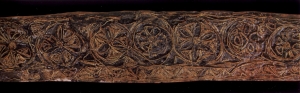
In the mid-twentieth century, excavations were carried out in the basilica of Saint Denis, the grave church of the Merovingian kings of the Franks. In this church, now in a suburb of Paris, a large number of sarcophagi were discovered. No. 49, discovered in 1959, yielded, so it appeared, the remains of Queen Arnegundis (Aregund, Aregunda, Arnegund, Aregonda, Arnegonda), the wife of the Frankish king, Clotaire I.
Chinese St. Sebastian
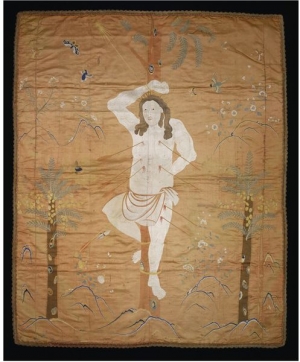
The Victoria and Albert Museum in London houses a silk embroidered panel with a representation of the Christian martyr, St. Sebastian. It dates to the eighteenth or early nineteenth century. The red colour of the background (now faded) corresponds with the colour normally associated in the Roman Catholic Church with martyrdoms.
Piña Fibre
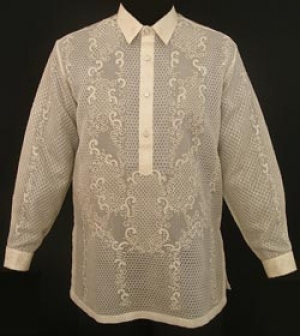
Piña is a fibre that is made from the leaves of the pineapple (Spanish: piña). It is especially used as such in the Philippines. Piña cloth was widely applied in the Philippines, especially for the barong tagalok, the embroidered shirt which is still being worn, especially for formal occasions.
Bed cover (China)
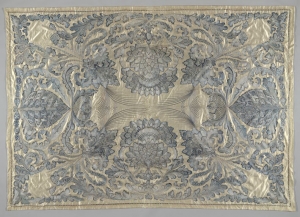
The Rijksmuseum in Amsterdam houses a bed cover made of silk satin with floss silk and metal thread embroidery, which was made in China in the early eighteenth century. The cover measures 330 x 235 cm. The cover goes with two other items in the Museum's collection, namely a bed (acc. no. BK-1958-20-A) and a bed curtain (BK-1958-20-C).
Herald's Tabard
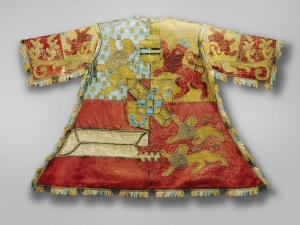
The Rijksmuseum in Amsterdam houses a richly embroidered herald's tabard (Dutch: wapenrok) that was worn at the funeral of Prins Frederik Hendrik van Oranje Nassau (1584-1647), stadhouder of the Netherlands, in Delft on 10 May 1647. Four heralds were wearing such a tabard; a fifth was held up on a standard (see engraving). This is the only one still extant, and measures 90 x 120 cm.
Admiral Michiel de Ruyter't Ducal Hat
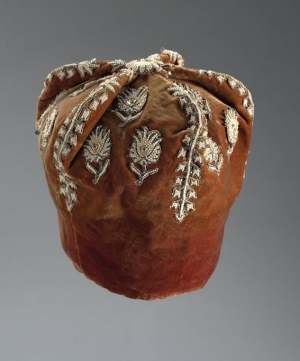
In 1675, the Spanish king, Charles II (1661-1700), presented the Dutch Admiral, Michiel Adriaansz. de Ruyter (1607-1676), with a ducal crown. The crown itself has been lost, but the tall, woollen hat that went inside the crown has been preserved, and is now housed in the Rijksmuseum, Amsterdam.
Veglia Altar Frontal
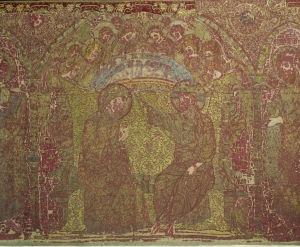
The Victoria and Albert Museum in London houses the so-called Veglia altar frontal, which was made in the early fourteenth century in Venice, Italy. It measures 107 x 277 cm. It is made of a red silk, with underside couching in metal and silk, and with coloured silk threads embroidered mainly with split stitch for the outlines and details.
Opus Consutum
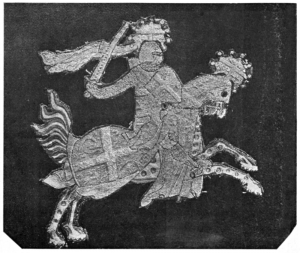
Opus consutum is mentioned in thirteenth century documents and may be translated as 'sewn-together work'. It would refer to intarsia or inlaid appliqué. The term is again used from the late-nineteenth century for appliqué work, especially from the medieval period. The word is first attested by the Roman Catholic priest and ecclesiast, Daniel Rock (1799-1871).
Tristan Hanging
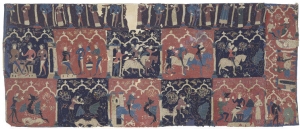
The Victoria and Albert Museum in London houses an (incomplete) appliqué wall hanging, popularly known as the Tristan hanging. It originates from North Germany and was made in the late fourteenth century. It is 109 cm high and 256.5 cm long. It is a dark blue, woollen cloth with appliqués of woollen fragments. It contains 22 scenes from the medieval Tristan and Iseuld (Isolde) legend.
Bed Tent Door

The Victoria and Albert Museum in London houses an embroidered bed tent door from the Dodekanesos, modern Greece. It dates to the eighteenth century. See also the entry on Greek bed tents.