

Quilted Cap from Afghanistan
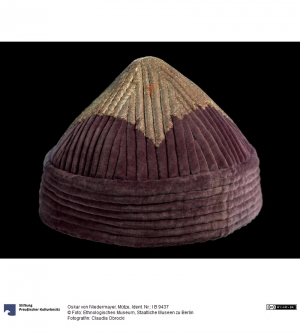
The Ethnologisches Museum in Berlin houses a quilted cap from Afghanistan, which was collected by Oskar von Niedermayer (1885-1948) when he was sent to Afghanistan by the German government to set up the Afghans against the British in India, during the First World War (1914-1918). The mission failed, and the German mission was forced to leave the country.
Medieval Embroidery Fragment, Switzerland
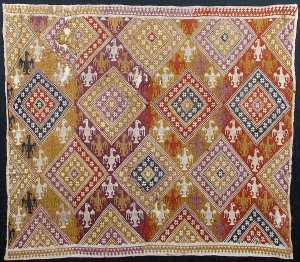
The Metropolitan Museum of Art in New York houses a piece of embroidery from Switzerland, which has been dated to the fourteenth century. The embroidery is worked in silk on a linen ground. It measures 61.8 x 70.6 cm.
Reliquary of St. Florian
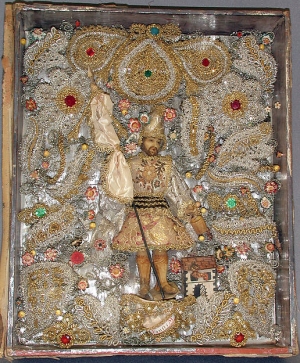
The Metropolitan Museum in New York holds a reliquary of St. Florian, which dates to the eighteenth or nineteenth centuries and originates from Austria. It measures 41.3 x 34.3 x 8.3 cm and is made of fabric with wax, glass, and with gold and silver thread embroidery.
Embroidered Linen Coif
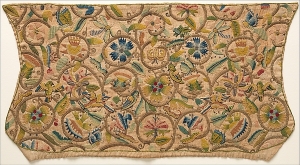
The Metropolitan Museum of Art in New York houses an intricately embroidered linen coif from Britain, made in the early seventeenth century. It measures 22.9 x 43.2 cm, and the embroidery is worked in silk and silver-gilt thread, together with spangles.
Needlecase with Scissors
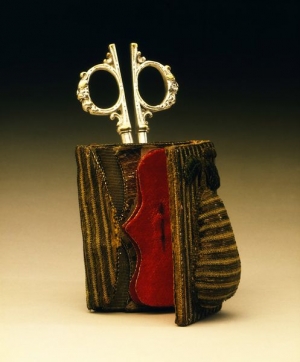
The Victoria and Albert Museum in London houses a late seventeenth century needlecase with scissors. The needlecase itself was probably made in Britain, but the scissors have been given a Dutch origin. When closed, the needlecase measures 8 x 7 cm. The case is made of embroidered silk, velvet and flannel.
Wedding Ring Pads
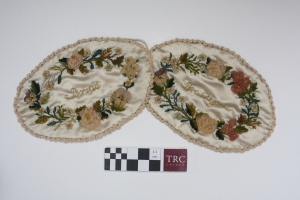
The Textile Research Centre (TRC), Leiden, houses a box and four ovals (two cushions and two 'real' covers) made of silk and embroidered in silk with floral motifs and, on two of the ovals, two texts, namely (in Dutch) bruid and bruidegom ('bride' and 'bridegroom') respectively (TRC 2014.1060a-e). The box and pads were intended to hold the wedding rings before the ceremony. The ensemble dates to 1827.
Madeira Postage Stamp
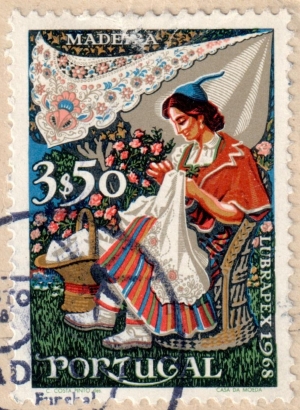
The Textile Research Centre (TRC) in Leiden houses an envelope with a stamp issued in 1968 showing a woman from Madeira dressed in traditional local dress and working her embroidery, presumably Madeira work.
Feestrok (Rijksmuseum)
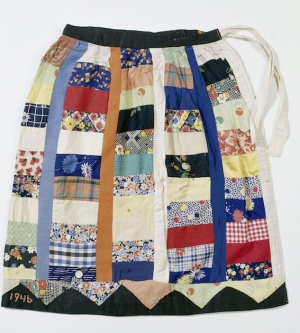
The Rijksmuseum in Amsterdam houses an example of a so-called feestrok. These 'celebratory skirts' were made as part of a large-scale programme to celebrate the liberation of The Netherlands from German occupation in 1945. They were forms of patchwork. A comparable feestrok is held by the Textile Research Centre in Leiden (TRC 2011.0001). For further information on this programme, see here.
Cotton and Silk Cloth from Iran or India, c. 1700
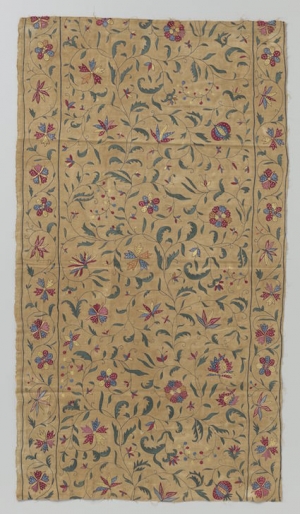
The Rijksmuseum in Amsterdam houses a fragment of a cotton cloth with floral patterns embroidered in silk. It has been dated to around AD 1700 and its origin may be Iran or India. It measures 75.6 x 42.5 cm. It may belong to the same cloth as another fragment, also housed in the Rijkmuseum (BK-NM-3614).
Knitted and Embroidered Shawl, c. 1851
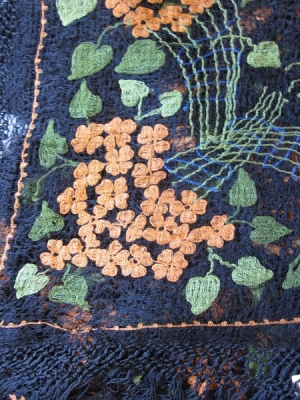
The Victoria and Albert Museum in London holds a knitted and embroidered shawl that was reportedly exhibited at the Great Exhibition of 1851. It was made of nettle fibre and measures 170 x 120 cm.