

Richelieu work, or Richelieu embroidery, is a form of cutwork lace. It was especially popular in the fourteenth to sixteenth centuries. Since the dominant colour is white, it may also be classed as a form of whitework. There are various designs, and these are outlined with buttonhole stitches and with bars connecting the open areas. The bars themselves are also provided with buttonhole stitches and picots.
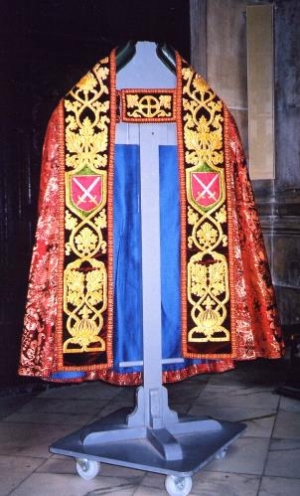
The King George Jubilee cope was commissioned and made in order to celebrate the silver jubilee of George V of Britain (r: 1910-1936) in 1935. Five copes were made that were worn during the official church celebrations in St. Paul's Cathedral, London (England).
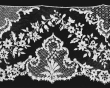
Carrickmacross lace is a form of appliqué net lace developed after the invention of bobbinet in the early nineteenth century. The design was drawn onto a backing cloth, which was tacked to an overlay of the bobbinet and a fine muslin (cambric). A couched outlining thread was used to attach the muslin to the bobbinet following the pattern, after which the excess material and backing cloth were cut away.
Couched satin is an alternative name for Bokhara couching. This stitch/term is associated with Mountmellick embroidery. GVE
Needle Arts is a quarterly magazine issued by the Embroiderers’ Guild of America Inc. The first issue came out in January 1970. It includes articles about historical pieces, projects, designer profiles, calendar of events, and so forth.
Minikin is a term used for a form of fine gold wire, more commonly known as pearl-purl.

The Boston fishing lady embroidery series is a popular name given to a series of embroidered pictures dating to the mid-eighteenth century, some of which feature women fishing. Such embroidered images were popular in the Boston (Mass.) region of the USA and were made by female members of prominent New England families attending various Boston boarding schools, as a ‘certificate’ of their embroidery skills.

Hitomezashi sashiko ('one-stitch sashiko') is a form of sashiko that is based on a pattern of straight lines. The stitches can be joined together or cross each other.

More...
Damask darning is a pattern darning techique that creates a very close appearance of a damask or brocade weave. WV

Illustrated is an example of an Indian turban band, now housed in the Victoria and Albert Museum, London. The band was made in either Faizabad or Lucknow (India) during the second half of the eighteenth century. The band is 64.5 x 10.5 cm in size (including the fringe). It is made of velvet on a canvas base. It is decorated with floss silk embroidery, silver and silver gilt wire and spangles.

A turban band was a highly decorative cloth and/or metal band that went around a Mughal-period turban in India. It was designed to embellish the turban rather than having a purely practical function. Such a band was often worn with other items of jewellery, such as a feathered aigrette and/or a turban brooch.