

Embroidered net lace is a needle lace form, which developed in Europe from about the fourteenth century onwards. There are two main forms of embroidered net lace, depending on the type of net being used, namely a hand knotted net ground (filet), or a machine made net ground (tulle or bobbinet), both with a stitched design.

Needlepoint lace is a needle lace form of lace, whereby a ground material is no longer an essential part of the finished product or indeed it is completely absent. Needlepoint lace can be described as a single-thread technique using embroidery stitches. In general, the main stitch used for needlepoint lace is buttonhole stitch. The basic techniques of needlepoint lace, roughly following its development, can be distinguished as follows:
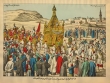
The mahmal is an embroidered palanquin (a form of travelling tent), specifically associated with the (symbolic) transport of the kiswa, the covering of the Ka`aba in Mecca, Saudi Arabia. A mahmal in its more general meaning was a covered construction perched on the back of an animal, usually a camel, and used to carry people, especially noble ladies and brides, who required a degree of privacy.
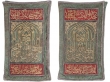
The decorated Ka'aba key bag is used to hold the key to the Ka`aba, a sacred Islamic building in Mecca, Saudi Arabia.
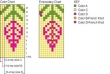
For centuries, lined and graph paper charts have been domestically and commercially available for creating counted thread embroidery designs, especially in cross stitch and tent stitch. Until the middle of the nineteenth century, coloured charts in Europe and America had to be hand painted in order to indicate the correct colours. Later in the century, machine printed charts became available.


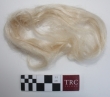
Dacron is an American trademark for polyester, a type of synthetic fibre. It was first marketed in the USA in 1951. By the beginning of the twenty-first century the trademark was used for a variety of polyester fibres and products, including an artificial sinew thread that is basically a waxed, polyester yarn.

Goldwork templates are made out of card, felt, leather, parchment or something similar. They are used at professional workshops and by embroiderers that produce goldwork.
More...
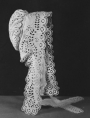
Cutwork lace is a form of cutwork and is also classed as a form of embroidered lace. Cutwork is a type of decorative needlework that consists of deliberately cutting out small spaces or holes from a ground material. There are different forms of cutwork (cutwork lace and cutwork embroidery), depending on whether the ground or the holes form the dominant element in the design.

Agnes Blencowe was an English embroideress and one of the founders of the Ladies Ecclesiastical Embroidery Society. She was the daughter of John Prescott Blencowe and Pleasance Everard, who had a total of eleven children, most of whom never married. Agnes Blencowe acted as housekeeper to her brother, the Rev. Edward Everard Blencowe.
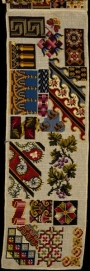
Berlin wool work, or briefly Berlin work, is a style of embroidery that is normally associated with the use of woollen yarn (tapestry yarn) on canvas. Berlin wool work was usually worked with the help of embroidery charts in a single stitch, notably cross stitch or tent stitch.