

Dictionary of Needlework, 1882
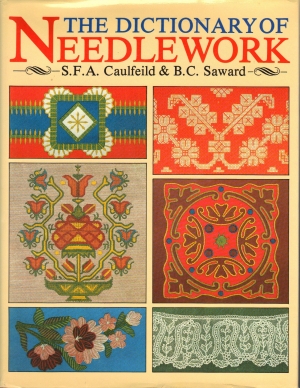
The Dictionary of Needlework is a late nineteenth century encyclopaedia written by Sophia Frances Anne Caulfeild and Blanche C. Saward. The first edition of the Dictionary of Needlework was published in 1882 (London: L. Upcott Gill) in six volumes.
Tippet

A tippet is a garment worn over the shoulders and around the neck. It is normally made out of a long, narrow piece of cloth, fur or similar material. It has been one of the religious garments in the Western world since at least the medieval period, but is also worn in secular situations.
Pelerine

In mid-nineteenth century England, the term pelerine referred to a waist-length cape that was often made of embroidered muslin, lace or net. In Germany and the Netherlands, a pelerine nowadays refers to a short cape that can be made of any material and was (is) used for both indoor and outdoor wear.
Buke ('Book') Muslin
See muslin.
Muslin
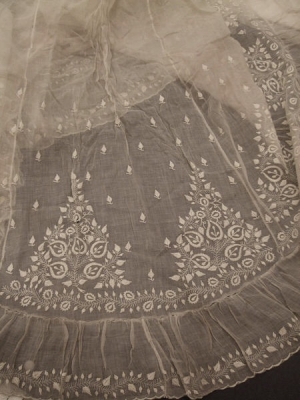
In the UK, muslin is the name for a very fine, almost transparent cotton fabric. It was used for ladies' garments, light weight curtains, hangings, etc. The first use of the word in England dates to the early seventeenth century and is related to the French term mousseline and the Italian mussolina and musselo, allegedly referring to the town of Mosul (in modern northern Iraq), or to the Indian port of Masulipatnam.
Hedebo Embroidery. The Different Styles (Denmark)
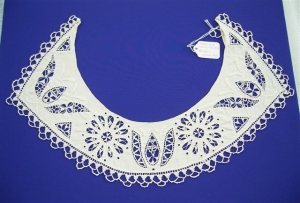
Hedebo is a form of whitework embroidery. It originates from a Danish farming community in the district of 'Heden', between Copenhagen, Køge and Roskilde. The term Hedebo embroidery covers seven different techniques, which were all embroidered on white linen tabby cloth with white linen thread.
Hedebo Embroidery. An Introduction (Denmark)

Hedebo is a form of whitework embroidery, related to reticella work. It is sometimes classed as an embroidered lace. It originates from the Danish farming community of the Heden, 'heath', area between Copenhagen, Køge and Roskilde.
Helen Whitty

There is a telling photograph from 1917 of a girl, Helen Whitty, working on a curtain decorated with drawn thread work in a commercial setting. She was fifteen years old when Lewis Wickes Hine (1874-1940) took the image. The company she worked for was Boutwell, Fairclough & Gold, 274 Summer Street Extension, Boston Massachusetts, USA.
Udklipshedebo (Denmark)
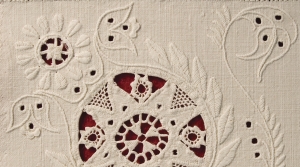
Udklipshedebo, or Hedebo needle lace, is a Danish form of whitework embroidery, often regarded as free-style, using cut work and embroidered lace techniques, which developed from the mid-nineteenth century, when Danish embroiderers started to fill in their traditional design patterns with embroidered lace, worked in buttonhole stitch and scallop stitch, thus developing a style called Udklipshedebo.
Twisted Beading Needle

A twisted (wire) beading needle is a form of beading needle, made from a single piece of stainless steel wire. The wire is twisted around on itself to form a needle, with a large round eye and a blunt end.