

Tulle Embroidery
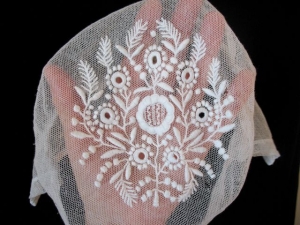
Tulle embroidery is a form of free style embroidery worked on tulle, a light weight and machine-made net. This type of embroidery appeared in the late eighteenth and became popular in the nineteenth centuries. Tulle embroidery is often regarded as a cheaper version of bobbin lace.
Tulle

Tulle is a lightweight, very fine form of net with a hexagonal mesh, machine-made and often starched. It can be made of various fibres, including cotton, nylon, rayon and silk. The word is often used synonymously with net. The name comes from Tulle, a city in the south-central part of France. Tulle was well known as a centre for lace and silk production in the eighteenth century. It is likely that early tulle netting originated here.
Trench Art
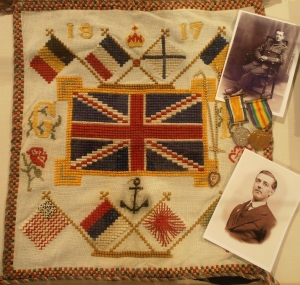
Trench art is a term used for objects made by military, civilians or commercial groups who were actively and directly involved in an armed conflict. Two well-known forms of trench art are the embroidered silk postcards dating from the First World War (1914-1918) and embroideries worked by POW's, often classed as trench art samplers.
Tobit Table Carpet
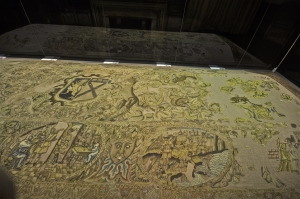
The Tobit Table Carpet is a sixteenth century table carpet (table cover) apparently made in 1579 by Elizabeth Talbot, Countess of Shrewsbury (1521-1608; also known as Bess of Hardwick). She was an accomplished needlewoman who produced many embroideries.
Tent Stitch

Tent stitch is an umbrella term for several different, but related free style and canvas embroidery stitches. A tent stitch is a small, diagonal stitch that crosses the intersection between the horizontal and vertical threads of the ground material. The term ‘tent’ derives from the French tenter, meaning ‘to stretch.’
Tatting
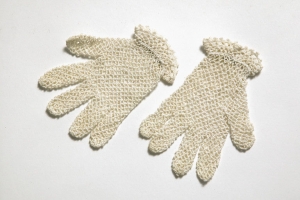
Tatting is a knotting technique used to make a form of lace with a series of knots and loops (picots or purls). It is made using a small shuttle. In Western Europe this technique seems to date to the late eighteenth century and may be a development of knotting. It became popular in the late nineteenth century.
Tambour Hook
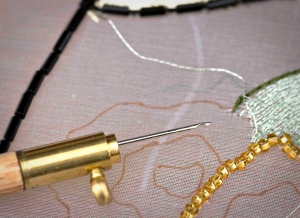
A tambour hook is a very fine hook housed in a wooden or metal handle, which is used to create a chain stitch while working tambour embroidery or tambour lace. In India, tambour embroidery is called ari embroidery and is carried out with an ari hook, which is comparable, but not identical to a tambour hook. The technique of creating the chain stitch is the same.
Syon Cope
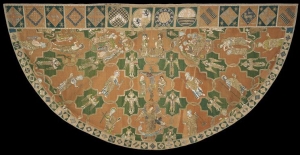
The Syon Cope is a Christian liturgical vestment associated with Syon Abbey, Middlesex (England). It was made between 1300 and 1320. Copes are semi-circular outer garments, usually highly decorative, worn by priests on special occasions. The Syon Cope was made from a much larger chasuble.
Suzani
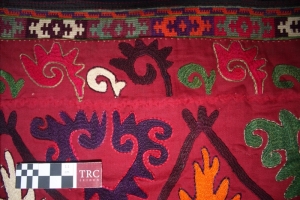
Suzani is the general term for a type of large, embroidered textile from mainly Uzbek communities in Central Asia, and found in Afghanistan, Kazakhstan, Kyrghyzstan, Tajikistan, Turkmenistan and Uzbekistan. The term derives from the Persian word suzan or ‘needle’ and suzanduzi for 'needlework'. The oldest surviving suzanis date from the late eighteenth century, but it is likely that their production and use date back to much earlier times.
Straw Embroidered Vestments from Prague
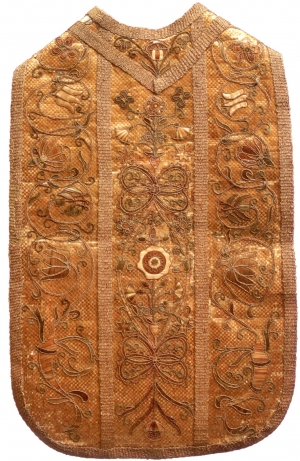
The Treasury of the St Vitus Cathedral in Prague, Czech Republic, holds a set of straw-made and embroidered religious vestments. The garments include a chasuble, maniple and stole (C.k. 114, cat. no. 84). They are all made out of decoratively woven straw. In addition, the garments are embellished with stylised floral motifs outlined in straw (2ply, Z-spun), which have been couched down using what appears to be a linen thread.