

Badla is a form of metal thread embroidery associated with various Asian and Middle Eastern countries. In India, Pakistan, Saudi Arabia and throughout the Gulf region the technique is usually known as badla. In (southern) Iran it is called khus-duzi, while in Egypt it is called tulle-bi-telli (‘net with metal’), which includes the French word tulle (‘net’).

Arpilleras reflect a South American folk art that uses appliqué, embroidery and patchwork to depict scenes of everyday life. The Spanish word arpillera derives from an old Spanish word for burlap or hessian cloth. They are sometimes called cuadros (squares). Most arpilleras are used as pictures and hung on walls. The most famous arpilleras and arpilleristas (the women who make them) are from Chile.
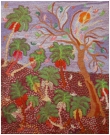
Akhmim embroidery is a form of modern ‘naive’ embroidery associated with the city of Akhmim in Upper Egypt. Textiles, especially woven forms, have been produced at the city for thousands of years. This relationship has been used by various Non-Governmental Organisations (NGO’s) to build up local weaving projects, especially for women, developing new weave and embroidery styles and bringing Muslim and Christian communities together.
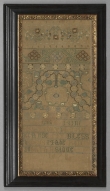
Sarah Stone's sampler is one of the earliest surviving American samplers, and was made by Sarah Stone in 1678. She lived in Salem, Essex County, Massachusetts (USA). The sampler is c. 42 x 19 cm in size and worked in coloured silks on a linen ground. It is worked in various stitches, including back stitch, cross stitch, detached buttonhole stitch, double running stitch, eyelets, long-armed stitch and satin stitch.

The Embroiderers' Guild is a British charity set up in 1906 by a group of sixteen former students of the Royal School of (Art) Needlework. They established a society to “deal entirely with embroidery, and with the first object of keeping up a high standard of work and design.”

Aida is an even weave cloth often used for counted thread embroidery. The material is mesh-like in construction for ease of stitch counting and has enough stiffness so that an embroidery frame or hoop is not necessary. Older forms of Aida are made of linen, while most twentieth-century examples are of cotton.

The Royal School of Needlework (RSN) is a British hand embroidery school founded in 1872. It was originally called the Kensington School of Needlework, and thereafter the Royal School of Art Needlework. The word ‘Art’ was dropped in 1922.
More...

A chasuble is a Christian liturgical vestment used in the Eastern and Western Churches. The term chasuble derives from the Latin word casula (cloak [previously called a paenula] literally a little house or cottage, casa), via the Late Latin term casubla, meaning a garment with a hood.

The town of Zabid lies to the south of Bayt al-Faqih, along pilgrimage and trade routes across the coastal Tihamah plain, about 50 km south of al-Hudaydah and 150 km southwest of the Yemeni capital of Sana`a. Traditionally, women from the Zabid region have worn two styles of embroidered dresses: daily and festive versions.
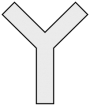
The Y-shaped cross, or forked cross, is a Christian symbol. It has been popular in western Europe since the early thirteenth century and its use later spread to other parts of the world. This form of cross is also known as the crucifixus dolorosus, the furca, the ypsilon cross, and occasionally the ‘robber’s cross’ or ‘thief’s cross’, because it was said to be the cross used for the two thieves who were crucified together with Jesus Christ.