

Patchwork is a form of needlework whereby two or more pieces of cloth are sewn together to create a larger, usually flat piece, which may or may not be decorative. This technique is found throughout the world and has been used for hundreds of years. It probably originated from the need to re-use (expensive) textiles. It should not be confused with the technique of quilting, which sews together, in layers, two or more pieces of cloth.

Elisabetta Catanea Parasole was a female Italian lace and embroidery designer who lived in Rome. She was married to Leonardo Norsini, a wood engraver (who adopted his wife's surname after marriage).
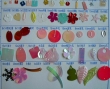
In the nineteenth century, a paillette was a simple piece of coloured foil or bright metal used to ornament textiles. In the latter half of the twentieth century, the term paillette was used for a much wider range of shapes and materials, with one or more holes to attach the shape to the textile. The term is often incorrectly used for a sequin (UK), which is a small disc with a single hole in the centre.

Matio (Matteo) Pagano (1515-1588) was a Venetian who published various books with lace and embroidery designs. His book titles were deliberately chosen to promote needlework as an acceptable activity for virtuous women.

A mellor is a blunt tool about 6-12 cm in length, which is paddle-shaped at one end and pointed at the other. It is a piece of equipment used for goldwork embroidery. The blunt end can be used as a laying tool, to help place the gold thread in position and, if necessary, to make the accompanying silk thread, used for sewing down the gold thread, lie flat.

Mother-of-pearl is a composite material produced by some forms of molluscs as an inner shell layer. The molluscs are notably mussels and oysters. The material is strong, resilient and iridescent. Mother-of-pearl has long been used in various parts of the world for making decorative buttons for garments.

Many embroidery designs in North Africa and the Middle East are passed down from one generation to another by copying older pieces of embroidery. However, it was not uncommon for girls and women in Morocco to decorate cloth with various forms of designs and stitches, and at first glance these pieces of decorated cloth seem comparable to European samplers.
More...

For centuries, Morocco has been known for the production of leather goods, which were sometimes embroidered in various techniques. The range of embroidered leather objects includes animal trappings (such as saddles), bags and satchels, belts, pillows, poufs, purses and wallets, stools, sword and dagger sheaths, as well as a range of slippers (babuch) for men, women and children.

Morocco lies in the extreme northwest of the African continent. It has a coastline along the Atlantic Ocean and the Mediterranean Sea. The region that is now Morocco has been inhabited since ancient times, and over the centuries many different ethnic and cultural groups have settled in the area, the largest groups being the Arabs who occupied the urban centres, and the Berbers who live throughout the country.
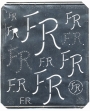
A monogram stencil is a piece of metal (usually copper, tin or zinc), about 18 x 16 cm in size (but this can vary), with sets of initials in different styles and sizes cut or punched out. The initials act as templates that can be filled in or outlined using a pencil or ink and then embroidered.

Miniature needlework, or miniature embroidery, is the embroidery of miniature designs on a very fine canvas. Many items are worked on a 1/12 scale (1 inch = 1 foot). Such items are often worked on a silk even-weave cloth with a thread (mesh) count ranging from 24 to 75 meshes per inch. The main stitch form used is petit point.