

Stevens, Helen (b. 1956)

Helen Stevens is an embroidery artist from Bury St Edmunds, England. In 1981 she established her own studio, called 'True Embroideries'. She exhibited her work at many venues, both in England and abroad. She has also been teaching in many ways, including via YouTube films, and she has published a series of books and brochures.
Museum of Textiles, Lyons
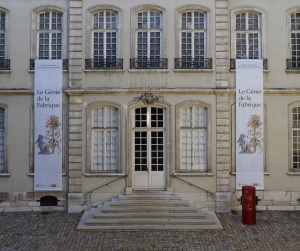
The Museum of Textiles (Musée des Tissus), Lyons, France, is one of the world’s most important museums dedicated to textiles and dress. It is actually half of a double museum, one of which is called the Musée des Arts Décoratifs (Decorative Arts Museum), and the other the Musée des Tissus (Museum of Textiles).
Njáls Saga tapestry
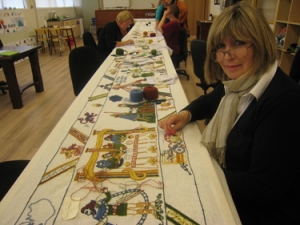
The Njáls Saga tapestry (njálurefill) is a modern embroidery that is based on a traditional Icelandic Viking story called Njáls Saga. It is deliberately being designed and embroidered in the same manner as the Bayeux tapestry. The embroidery is being stitched in Hvolsvöllur in southern Iceland.
Refilsaumur
Refilsaumur is the Icelandic term for laidwork. The earliest reference to this term dates from the mid-sixteenth century.
Refill

Refill is the name for an Islandic form of wall hanging that was decorated with embroidery. This type of wall hanging was popular from the late ninth until the end of the sixteenth centuries. The wall hangings were used to decorate the interiors of Icelandic secular dwellings. With the advent of Christianity in Iceland around AD 1000, refills were also used to decorate churches.
Groupe Broderie de CIETA

CIETA is an international textile society that was founded in 1954. The abbreviation CIETA stands for Centre International d'Études des Textiles Anciens.
Holland
Holland or Holland cloth is a tabby woven, matt linen cloth used as a furniture cover, window cover, jar cover, and so forth.
Spanisshe Stiche
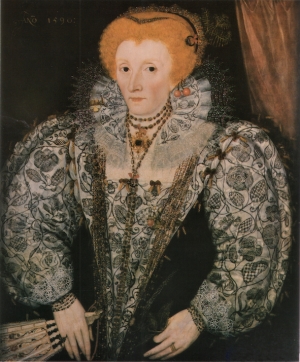
The 'Spanisshe stiche' was a mid-sixteenth century English term for a double running stitch (also known as the Holbein stitch). In Henry VIII’s inventory of 1547, for example, there is a reference to a cloth (either a napkin or coverpane) “wrought with redde Spanisshe stiche mailed betwixt two borders".
Coverpane
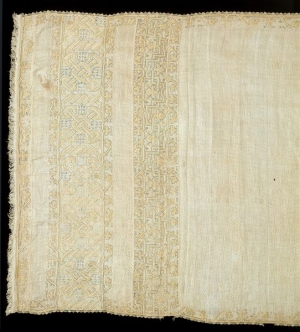
A coverpane (also written coverpaine) is a length of fine cloth that was used to cover the bread (Fr. pain), knife, salt, spoon and the trencher (together called the place setting) for the head of a household. In England coverpanes were popular during the Tudor period (1485-1603).
Maniple
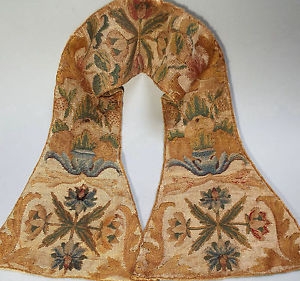
A maniple (also sometimes known as the fanon) is a liturgical vestment that consists of a band, often embroidered with silver thread, that hangs down the left arm of the wearer. It is a garment, usually made of silk, used mainly in the Catholic Church, during the celebration of the mass and worn together with the chasuble. Its colour follows that of the other liturgical garments and accords with the liturgical calendar.